By Emma Dion // February 27, 2020
WASHINGTON – In the heat of the 2020 primary season, a large pool of Democratic candidates are working hard to appeal to voters on a national scale. South Bend Indiana Mayor Pete Buttigieg champions his pro-LGBTQ family values through his own marriage. Vice President Joe Biden has called for policies to help minority African American families find prosperity. Presidential hopefuls are concentrating their platforms on new and improved policies that will generate interest from an increasingly diverse voter pool in the United States.
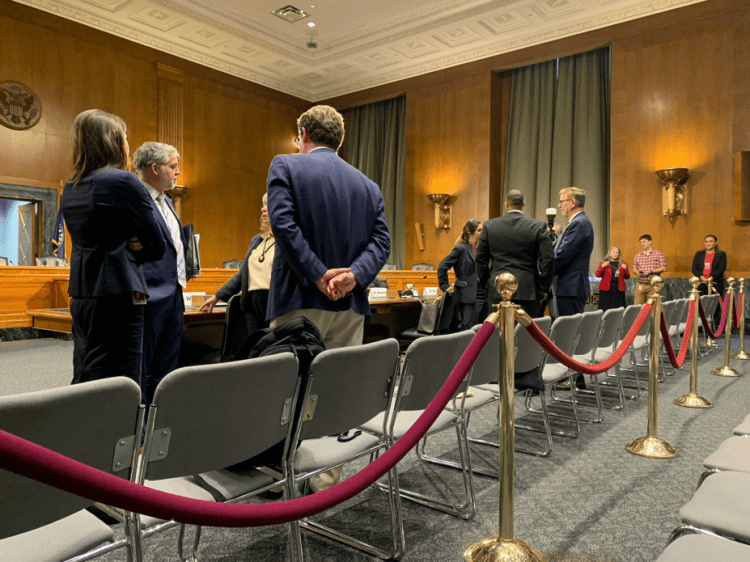
The Joint Economic Committee heard testimony from four sociology experts on Tuesday afternoon at a hearing to discuss “Improving Family Stability for the Wellbeing of American Children.” Much of the hearing focused on the current family-related policy in the United States, which lacks the ability to support non-traditional and minority families. The testimony panel debated for over two hours about various solutions to fix this problem.
Dr. Rashawn Ray, a David M. Rubenstein Fellow from The Brookings Institution, was the only person of color to provide testimony at the hearing and began his testimony with a question for those in the room to consider.
“I grew up in a single parent household and have never seen my biological father before. I am now happily married to my high school sweetheart with two smart and talented boys. How did I get here?”
Dr. Ray credited his successful upbringing to the determination of his single mother, Joslyn Talley, and the childcare and support that he received from his grandparents and aunt.
Dr. Ray’s testimony spoke to the fact that when minority families are facing economic hardship, they turn to extended family arrangements for help. His research suggests that racially diverse families today are more likely to consider extended kin and grandparents as part of their family.
This growing trend is not reflected by government policy currently in place. As Vice Chairman Don Beyer (D-VA) stated in his opening remarks, “the share multi-generational households has grown, but our policies haven’t changed. Grandparents, aunts and uncles are taking care of kids and are often doing it because the cost of childcare is unbelievable.”
Dr. Ray’s sentiment was echoed by Professor of Economics and Public Policy at the University of Michigan, Dr. Betsey Stevenson, who called for better recognition and support for broader kinship relationships in her testimony. Stevenson pointed out that grandparents are playing an “important role in childrearing both for married and single parents,” because research shows that couples who live far away from their parents will likely move closer once they have children.
When asked by Joint Economic Committee member and U.S. Congresswoman Jaime Herrera Beutler (R-WA) how policy makers should recognize the role of grandparents, aunts and uncles in providing care for kids, Dr. Ray was quick to suggest that “there needs to be greater flexibility and malleability in grandparents’ ability to take on some of the recourses and tax breaks associated with raising children.”
Not everyone in the room was in agreement that grandparents are the key to increased family stability. According to Kay Hymowitz, a William E. Simon Fellow at the Manhattan Institute, the focus needs to be on the “marriageable men problem,” something Hymowitz considers to be “an underappreciated part of the story.”
According to Hymowitz, as more and more women are getting higher education and entering the workforce, they are searching for men who also have higher education and well-paying jobs. Unfortunately for them, statistics show that fewer men are seeking that. Therefore, there is a “mismatch between what women might want [in a marriage], and the men available.”
Hymowitz suggested policy ideas that offer methods to fix this marriageable men problem- “to ensure more children grow up in stable, two-parent families, we need to focus our attention on young men.” According to Hymowitz, that means focusing on improving their education.
Hymowitz also drew attention to something “less amenable to government policy but is no less crucial to addressing the marriageable men problem.” In her testimony, Hymowitz brought up the need to re-affirm the importance of fathers and male contributions to the American family household.
Despite not having a father in his childhood upbringing, Dr. Ray agreed with this sentiment, explaining that although his mother wasn’t able to show “what it means to be a black man in society,” she was able to introduce Ray to figures who could, which proved importance in his life.
Bringing the hearing in a new direction, Congresswoman Herrera Beutler urged a conversation about emotional health in relationships. She questioned the testimonial panel on the types of relationships society is modeling in 2020, asking “who wants to get married if they’ve seen a terrible marriage, or a terrible situation?”
In response, Dr. Stevenson pointed out that families with fathers who have an increasingly large role are the families finding success. She pressed that “modern masculinity does involve having a baby pouch on some of the time.”
Dr. Stevenson’s message faced some backlash from Hymowitz, who was fast to object that having fathers participate more in family life “is not going to happen without marriage in any reliable way.”
As the Hearing was coming to a close, Congresswoman Herrera Beutler expressed her belief that mutual love and respect is “ultimately how we get to more stable relationships and marriages.” This idea was something everyone in the room could agree on.
Vice Chair Beyer addressed the fact that Congress has been working to pass legislation to improve economic stability for families. “I’m very pleased that our congress recently adopted the National Defense Authorization Act, which gave federal workers 12 weeks paid leave to care for a newborn or adopted child. I’m looking forward to expanding that to the private sector also.” But lawmakers aren’t nearly done making improvements for diverse, minority families. Beyer stated that upholding fatherly figures in the household is essential for future legislation. “Making paid family leave a reality for women and men will be another important step.”
 Advanced Reporting Times, Spring 2020