With every new administration, religious nonprofits, who lobby on issues relating to the core values of their faith, have had to build new relationships with staff and elected officials in the executive branch. With the Trump administration, some religious organizations have had to rethink the strategies they use to change public policy.
“If you’re not at the table, you’re on the menu,” said Raahima Shoaib, communications and marketing manager for Muslim Public Affairs Council, in a phone interview. Organizations like Shoaib’s and others have found it difficult to work with the Trump administration compared to previous administrations.
Since 1970, there has been a fivefold increase in religious advocacy in Washington, D.C., What started out as fewer than 40 groups, has increased to over 200 today. Collectively, these organizations spend over $350 million a year on attempting to influence national public policy, according to the Pew Research Center’s study, Lobbying for the Faithful.
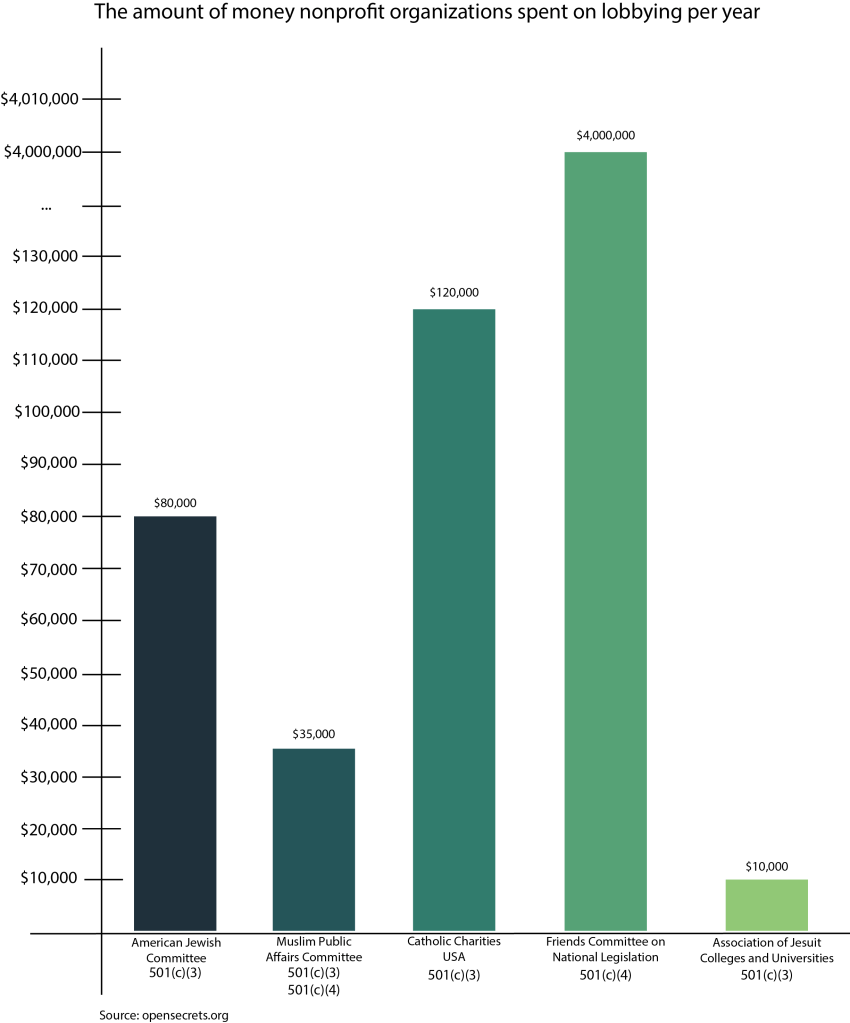
“Once the Trump administration took over, I think that was a pretty big avenue of our work that we needed to reconfigure,” Shoaib said. “They’re not really willing to engage with American Muslims and we’ve seen that over and over again.”
The Muslim Public Affairs Council shifted their focus from the executive branch, towards Congress when Trump was elected. Shoaib said the response from members in the legislative branch has been positive. “Most people are really open to hearing the other side, it’s just about having the access to do that.”
The organization advocates within the government to defeat misconceptions about American Muslims, and speaking out against Trump’s travel ban on Muslim majority countries. Their main strategy for lobbying is engaging with elected officials, policy makers and civil servants through dialogue. “You need to be in the room that those policies are created,” Shoaib said.
Catholic Charities USA focuses on a variety of topics, ranging from immigration and refugees, to affordable housing and the opioid crisis. Anthony Granado, vice president of government relations, said in an interview, engaging with the Trump administration has been challenging. “There have been tensions over a variety of issues that have impacted what has been a very cooperative, collaborative relationship between the nonprofit sector, … , and the government,” he said.
There was more of a realistic approach to communication when working with the Obama administration, Granado said. “They knew the areas where there was disagreement, and we agreed to disagree.”
Refugee resettlement has become a new concern within the organization because the Trump administration is allowing record low amounts of people to come into the United States, Granado said. Because of this, Catholic Charities will be forced to close many of their refugee resettlement camps because there won’t be any funds, “and there certainly won’t be any refugees.”
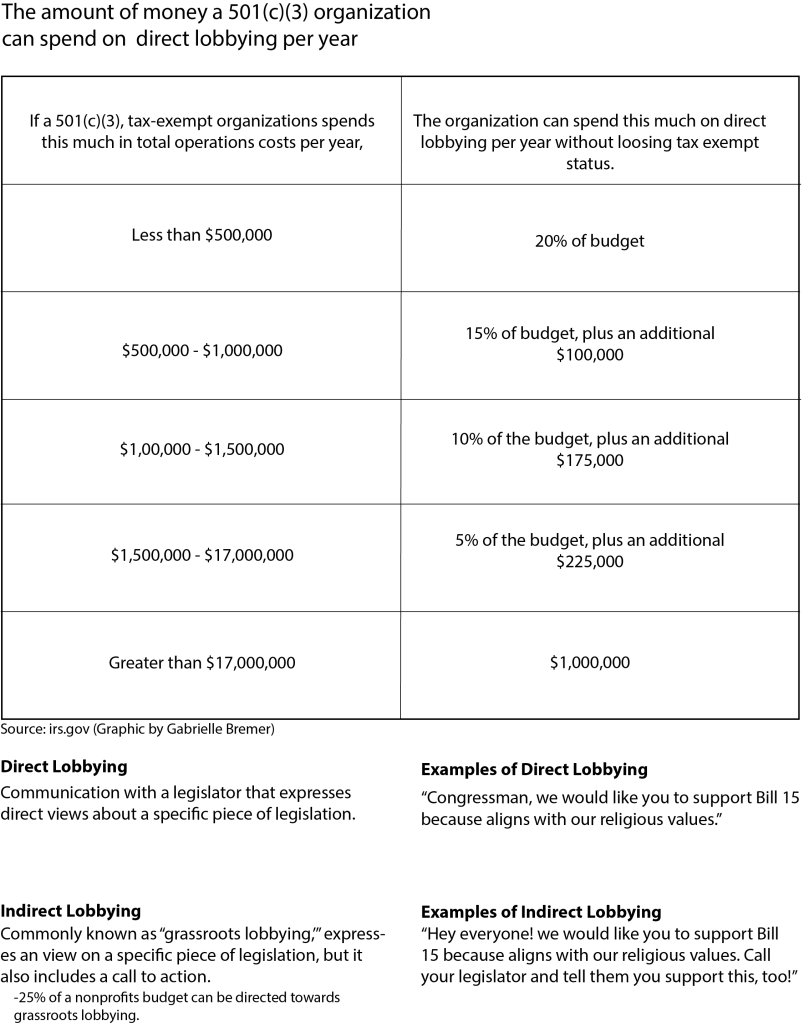
The Internal Revenue Service has strict guidelines on how much nonprofits can lobby. For an organization to qualify for section 501(c)(3), they can’t devote a substantial amount of its activities to lobbying. For a group that spends less than $500,000 a year, they can spend up to 20% of their total lobbying.
Some 501(c)(3) organizations create a 501(c)(4) companion that allows the nonprofit group to conduct significant amounts of direct lobbying. However, the two organizations must remain two separate entities, and the 501(c)(3) cannot give funds to the 501(c)(4), the Pew Research Center study, Lobbying for the Faithful, said.
“Each administration brings with it its own personalities, and its own issues it champions better than others.” said Jackie Subar, assistant director of political outreach for the American Jewish Committee, in an interview. “We’re always moving and shifting to figure out where we fit within new administrations.”
American Jewish Committee focuses on a wide range of domestic and international issues. Right now, the group is working on combatting the rise in anti-semitism in the United States and Europe. Subar said one of the key ways they conduct their lobbying is by attending meetings and strategy sessions with members on Capitol Hill. “Building relationships on the Hill is always important to getting things done,” Subar said.
Friends Committee on National Legislation, a 501(c)(4), Quaker lobby organization, has also stressed the importance of building relationships, and maintaining an open dialogue with government officials. Sergio Mata-Cisneros, young adult outreach program assistant, said in a phone interview, “We’re there to have a dialogue and build a relationship with them to see how we can work together to address the concern we’re meeting about.”
“What we lobby is rooted within our faith. As Quakers, we believe there is that of God in everybody,” Mata-Cisneros said. There is good within every administration, and the organization has found room to work with Trump’s staff. However, the administration has also put forth legislation that doesn’t align with their values.

Other religious organizations have had difficulties communicating with the administration. Jennifer Smulson, the director of Government relations for the Association of Jesuit Colleges and Universities, said in an interview, there are times where organizations can be on the offensive side. She can go into meetings with government officials who are very receptive to her concerns. However, “I think the Trump administration has put us in a very defensive position,” she said.
Smulson said this administration isn’t as willing to engage in dialogue compared to previous ones. There isn’t as much of a value placed on higher education, which creates slow progress. “Anytime that we see an increase in pell grant funding, … , even as small as it can be, I would look at that as a victory,” Deanna Howes Spiro, director of communications, said in an interview.
“Everyday, you’re going in, bracing yourself for ‘what are they going to do today?’” Smulson said. Other organizations who are having similar frustrations with the Trump administration are feeling the same way. However, some are trying to make the most of their time with this president and his staff, and accomplish as much as they can. “Real change happens when you’re able to change the hearts and minds of people,” Shoaib said.
 Advanced Reporting Times, Spring 2020