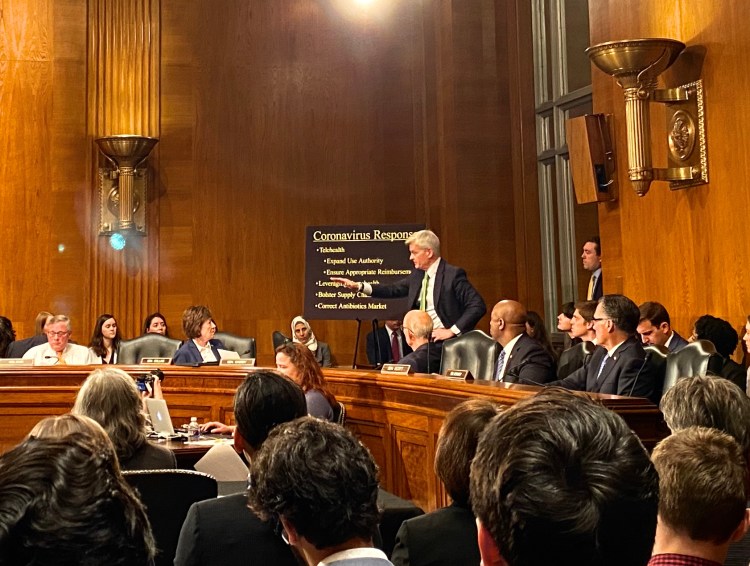
WASHINGTON—Senators of the Committee on Health, Education, Labor, and Pensions said at a March 3 hearing that the U.S. must prioritize certain individuals and long-term care facilities in planning its response to COVID-19, or the novel coronavirus.
The Director of the National Institute of Allergy and Infectious Diseases, Dr. Anthony Fauci, said that the U.S. does not have the amount of ventilators and other breath support devices that it needs to support the 15 to 20 percent of individuals who are more vulnerable to this illness. “Interventions are going to be critical” for those individuals, Director Fauci said.
The Senate committee hearing gave Director Fauci and three other health experts the opportunity to update politicians on the plans each of their departments is implementing to stop the spread of the respiratory illness.
The Commissioner of the U.S. Food and Drug Administration (FDA), Dr. Stephen Hahn, said, “We should have the capacity by the end of the week to have kits to the laboratories to perform about a million tests.” Some senators said FDA’s communication has been contradictory in recent weeks and expressed skepticism that one million test results will be available by Friday.
Sen. Christopher Murphy (D-CT) said that realistic expectations must be set to effectively combat the spread of the virus. “Your estimate that by the end of the week there are going to be a million tests out there does sound a little aggressive given the fact that we’ve only tested three thousand people,” Murphy said.
“We don’t want to go through all our tests on low-risk situations and not really be able to address the care and the contacts that are going to be critical,” Dr. Anne Schuchat, the principal deputy director of the Centers for Disease Control and Prevention, said. “People with severe respiratory disease who don’t have an obvious diagnosis should be tested.”
Director Schuchat said public health labs should be able to analyze 75,000 tests by the end of the week, which contradicts the prediction by the FDA.
This prioritization extends to medical equipment, as Dr. Robert Kadlec, the assistant secretary for preparedness and response at the Department for Health and Human Services, said that the U.S. only has 10 percent of the materials it needs in the strategic national stockpile if the virus becomes a pandemic.
Director Fauci acknowledged that the national stockpile does not include face masks, but he also believes that the general public does not need them. “Right now, there is not anything going around in the community, certainly not coronavirus, that is calling for the broad use of masks, Fauci said. The best way for individuals to combat the coronavirus is to wash their hands and get their flu shots, Fauci said.
Those more susceptible to the virus need ready access to respirators and face masks, so those items should be reserved for them, Fauci said. In fact, the health experts urged the public to refrain from creating personal stockpiles of materials. “A key planning principle is to protect the most vulnerable,” Director Schuchat said. The best way to do this is to make sure the public is well-informed, Schuchat said, and she pointed to the CDC website as a resource.
Medical resources could be bolstered by a bipartisan emergency supplemental funding agreement that Congress is working on. The agreement would also fund vaccine development, which experts estimate could take up to a year.
A Senate vote within the week is also likely to decide how much should be appropriated from the nation’s infectious-disease fund for this outbreak. Ranking Member Sen. Patty Murray (D-WA) said these additional efforts could make up for the inadequate funding President Trump allocated to combatting covid-19.
Murray said she was also worried about the 27 percent of private sector workers who do not have the opportunity to take paid sick leave (Murray did not cite the source of this figure but the Federal Bureau of Labor Statistics estimates it at 24 percent). Murray urged the floor to consider implementing a policy that would allow these low-income workers to stay home should the need arise.
“When those people’s basic needs are not met, they can’t make choices to protect themselves, which means they can’t make choices to protect others,” Murray said of those without access to paid sick leave or child care. “One person getting sick has repercussions for all of those around them.”
Senators also acknowledged that parents face difficulties if their children need to stay home from school for two weeks. School closures are locally-driven, but the CDC recommends, “Shift to staying home when you’re sick, perhaps canceling assemblies, changing the patterns of what’s done in class,” Director Schuchat said. The goal is “trying to keep classes going because so many depend on school lunches and other services that are at schools,” Schuchat said.
In Sen. Murray’s state of Washington, there have been six confirmed coronavirus-related deaths and worry is beginning to spread. “Families deserve to know, and fast, when testing will actually be ready to scale up,” Murray said. Assistant Secretary Kadlec said that healthcare providers are still months away from providing rapid coronavirus testing for individuals.
Director Fauci also raised the possibility that the virus could disappear in the summer months and return with colder weather later in the year. “It may be seasonal and come back, that’s quite possible,” Fauci said.
Sen. Murray lamented President Trump’s response to the coronavirus, saying that a politician [Vice President Mike Pence] should not lead efforts to combat a health crisis. “To put it simply, if someone at the White House or in this administration is actually in charge of responding to the coronavirus, it’d be news to anybody in my state,” Murray said.
Most people in the U.S. are at low risk according to the World Health Organization, Committee Chairman Lamar Alexander (R-TN) said. Sen. Tim Scott (R-SC) said that health experts must find a balance between urgency and alarmism. “We should be acting with a sense of urgency but not buying into hysteria that will make it even more difficult for healthcare providers,” Scott said.
About one hundred individuals in the U.S. have contracted COVID-19 in the U.S. compared to 90,000 people worldwide. About half of U.S. cases included those flown from overseas and quarantined for two weeks on the west coast.
To further contain the virus’ spread, Sen. Alexander said the Department of State recommends citizens avoid traveling to China, Italy, or South Korea. As more information emerges, the government may modify its recommendations. President Trump imposed travel restrictions on foreign nationals who have traveled to China or Iran in the past two weeks.
Sen. Alexander ended the hearing by focusing on the U.S.’s economy and reliance on China for drug imports. The percentage of how many drugs come to the U.S. from China is unclear, but Alexander said that this virus has shown the U.S. that it should not rely solely on one source for drug manufacturing. When the coronavirus is no longer the government’s main focus, it intends to turn its attention to diversifying the nation’s drug supply, Alexander said.
 Advanced Reporting Times, Spring 2020