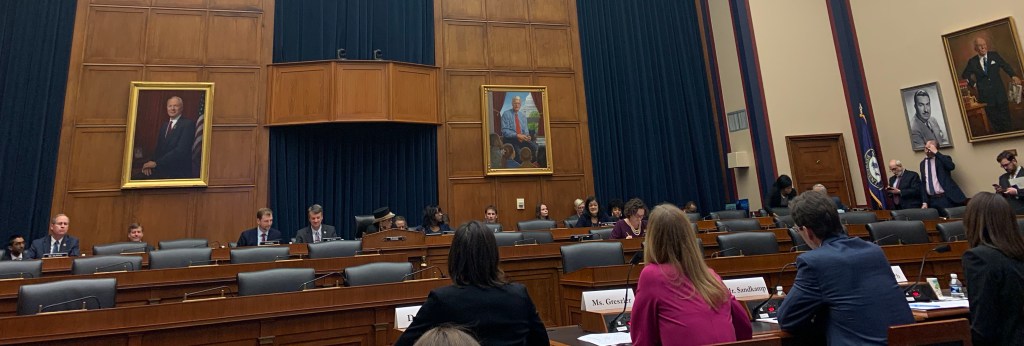
WASHINGTON – Witness and members of the Workforce Protections Subcommittee debated whether the provisions of the Family and Medical Leave Act should be changed to include those that are in the FAMILY Act.
The hearing featured testimony from two policy fellows, a member of the North Carolina General Assembly and a small business owner.
The FMLA was created in 1993 under the Clinton Administration to provide unpaid leave in the event of an illness or birth of a child. To be eligible for FMLA, an employee must have worked for the company for the past year, worked at least 1,250 hours in the past year and work for a company that has at least 50 other employees.
There is currently a piece of legislation, H.R. 1185 FAMILY Act, in front of the House Ways and Means Committee that would allow for every employee, regardless if full-time or part-time, to take a paid leave from their job for up to 12 weeks. The payments received would equal an employee’s monthly wage and will be distributed by the Social Security Administration.
Testimony began after opening remarks from Chairwoman Alma S. Adams (D-N.C.) and Rep. Ben Cline (R-Va.). Adams argued for the expansion of the act to cover all employees regardless of their employment status would have positive impacts for all parts of society.
“For families, paid family and medical leave mean improved maternal and infant health as well as better long-term outcomes for children,” Adams said. “For businesses, it means stronger work recruitment, increase in employee loyalty and reduced employee turnover rate. For the economy, … means more money in the pockets of American consumers and a reduced need for public assistance.”
While Cline agreed that there is a need to revise FMLA, he believes that one set policy will not work for every business in the country.
Cline said, “The bottom line is that Congress should avoid burdening the American taxpayer and employers through additional ‘Washington knows best’ federal mandates when the private sector is already innovating solutions to create workplace flexibility for employees.”
According to witness Elisabeth Jacobs, a senior fellow at the independent think-tank Urban Institute, “these qualifications restrict 44% of workers in the country from using FMLA.”
Rep. Sydney Batch from the North Carolina General Assembly was the first to testify in support of the expansion of FMLA and the passage of the FAMILY Act. Batch is also an owner of a small legal firm and has used FMLA in the past. She said this had shaped her opinions on the topic.
“Ensuring all workers—including those who work at a small business, those who work part-time, and those that are recent hires—have job protection through the FMLA is essential,” said Batch. “The FAMILY Act is the best paid family and medical leave insurance leave bill; its passage is a priority for families and small businesses.”
Batch also described how there is a proposed bill in the North Carolina legislature that would provide paid leave for all employees in the state. She is an advocate for this bill but said she wishes federal legislation would pass that way every American would have access to paid leave.
Anthony Sandkamp, a small woodshop owner from Jersey City, New Jersey, also gave testimony in support of the expansion of FMLA and the passage of the FAMILY Act. He said that his woodshop adapted to the paid leave act issued by the state of New Jersey in 2009 for proof that small businesses can prosper while still contributing to paid leave insurance. Employees at his business have used this program and were able to return to their jobs after.
“I have not had a single employee quit since the family leave has been available in the state of New Jersey,” Sandkamp said. “That is a huge cost savings to me as an employer in terms of productivity and the costs to train a new employee.”
Rachel Greszler, an economic research fellow from the conservative think tank Heritage Foundation, had a more critical approach to the expansion of FMLA and the passage of the FAMILY Act. She expressed that the government cannot make a one size fits all plan for businesses.
Greszler said, “The FMLA and other regulations that put politicians and bureaucrats in charge of decisions … end up limiting the ability for workers and employers to sit down together to figure out work plans that balance both of their needs.”
Geszler maintained that the definitions for what constitutes an illness in FMLA are too broad and this causes people to abuse the system. “In current FMLA, a serious medical condition is not well defined,” she said. “And employers have had employees report conditions, such as a hurt toe or migraine or a sever cough, that end up resulting in FMLA certification.”
She also does not support the FAMILY Act because “paid family and medical leave can’t be free.” The Heritage Foundation did a report on paid family leave where they showed it would raise the short-term deficit by $3 million and weaken the social security system
The last witness was Elisabeth Jacobs, a senior fellow at the independent think-tank Urban Institute, who supported both measures.
“The historic passage of the FMLA in 1993 has had important positive effects for families and workers with minimal evidence of negative consequence for business or economic growth,” Jacobs testified.
She also argued that FMLA and the FAMILY Act would improve federal labor laws for the 21st century and would create uniform policy. There are some paid leave laws on the state level, but not every state has them. The FAMILY Act would create a federal policy that would not vary from state to state.
Jacobs said, “A federal program with uniform eligibility requirements, protections and benefit schedules would eliminate the unevenness between the states and create a level playing field for state finances for employers and for workers.”
 Advanced Reporting Times, Spring 2020