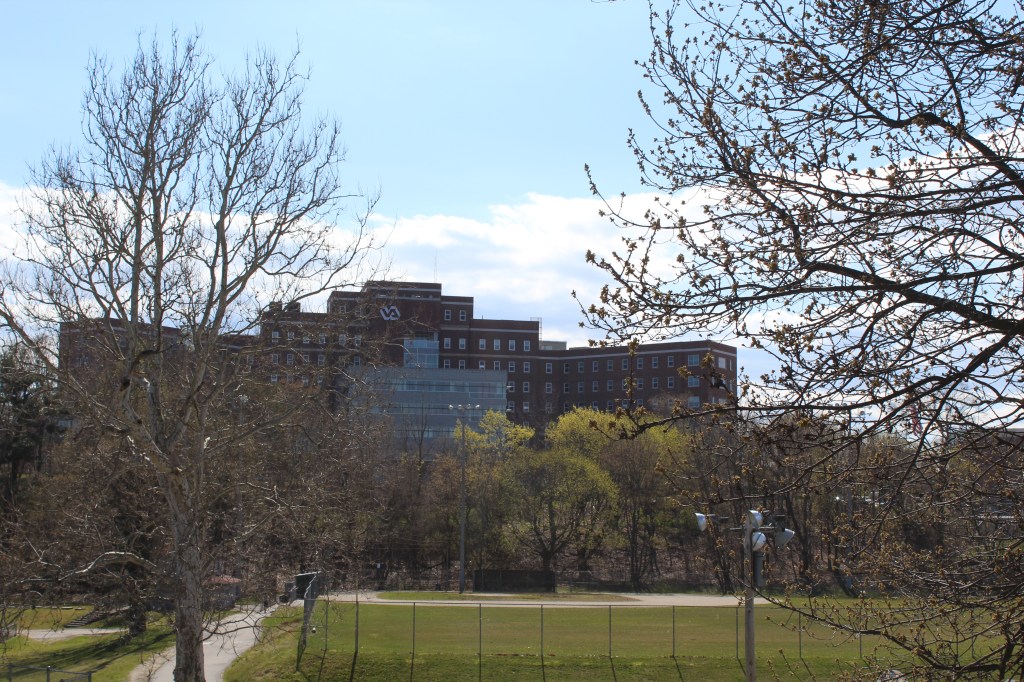
by Lindsay Russell // May 3, 2020
PROVIDENCE – “You know those people who just hate everything, no matter what?” Master Sgt. David Silva asked. “Those are the people who don’t want to use the VA.”
Silva, an Army veteran and an Army reservist for 35 years, has been receiving his medical care from the Department of Veterans Affairs medical centers since the 1980s. In the decades since, he has fallen from a roof, broken ribs and legs, gotten sick, and started monitoring his blood pressure. The medical staff at the VA, he says, has been there for all of it.
“I have one bad experience here,” he said, laughing. “On Thanksgiving morning in what had to be 2016, the grits in the cafeteria…were cold…And that is my only bad experience.”
Silva recounts his personal history with the VA as the department approaches the one-year anniversary of the implementation of the VA MISSION Act of 2018. The law, which went into effect in June 2019, expanded the number of veterans who are eligible to receive private healthcare, subsidized by the VA.
The pressure to cut down on wait times at VA centers was reignited after a 2014 scandal at a VA hospital in Phoenix, where wait times were being drastically underreported. A document initially hidden from federal regulators revealed that veterans had to wait an average of 115 days to see a primary care doctor. A report from the Office of the Inspector General found that the wait times contributed to the deaths of as many as 40 veterans.
The VA MISSION Act makes veterans eligible for private care if a veteran cannot get an appointment at a VA center within 20 days of requesting primary care or mental health care and 28 days of requesting specialty care, unless the veteran agrees to a later appointment.
Veterans are also eligible for private care based on the average drive time from their home to the closet VA medical center. Veterans who are more than a 30-minute drive are eligible for private primary care, and those who are more than a 60-minute drive are eligible for private specialty care.

According to a VA press release from the day the program launched, the program is meant to “empower veterans with increased access to community care.”
Although Silva has qualified for private care as a result of a 30-day wait time at the Providence VA Medical Center, he chose to wait until he could see a VA physician.
“If I go to an outside provider, I don’t even know who that person would be… They can’t review all my records they have here at the VA,” he explained. “In my opinion, I think it’s a disservice [to me] because they don’t have all my information.”
For Silva, it was reasonable to wait a few extra days to see his doctors. For other patients, the priority is seeing a physician right away, and this program makes that possible.
“I like the care at the VA, for the most part,” said Tech. Sgt. William Stranahan of the Air National Guard. “I did have an experience where they sent me to an outside dermatologist because they couldn’t get me into the [Providence] VA in a reasonable amount of time.”
For veterans living outside the small state of Rhode Island, the drive-time eligibility requirements make it easier to fit doctor’s appointments into their schedules. In larger states and more rural areas, getting to a VA center isn’t so easy.
Coast Guard veteran Tommy Oates is a pharmacist at the White River Junction VA Medical Center in central Vermont, just across the Connecticut River from the New Hampshire border.
“Up here being a rural facility, we are granting a lot of patients the ability to go see outside providers,” Oates said. “Because some of these patients are, you know, living up on the Canadian border. It’s a couple hour drive just to come to our facility.”
But Oates explained that even under the VA MISSION Act, patients cannot have their private doctors send their prescriptions to a CVS Pharmacy, for example.
“If somebody was in the Burlington area, that’s like a solid two-hour drive, maybe a little bit more, to our facility,” he said. “So, we would get the prescriptions… electronically prescribed. Then then we would mail it to the patient, and if it’s an emergency, we’ll UPS it to them.”
While the new stipulations in the VA MISSION Act are expanding veteran choice, some House Democrats worry about spending money meant to fund the VA on private care. Generally, Republicans tend to favor sending veterans to private doctors, while Democrats tend to favor investing in more VA doctors and facilities.
In June 2018, then-Rep. Tim Walz, the top Democrat on the House Veterans’ Affairs Committee at the time, issued a press release outlining his concerns about the VA MISSION Act.
“[Budget caps] means current programs investing in VA infrastructure, direct patient care, suicide prevention, medical research… could face cuts in funding in order to pay for care in the community under this new plan,” Walz said in the statement.
The political contention surrounding the creation of the new program prompted the VA to release a statement before the bill received a vote in Congress.
“There is no effort underway to privatize VA, and to suggest otherwise is completely false and a red herring designed to distract and avoid honest debate on the real issues surrounding Veterans’ health care,” the release said.
In March 2019, Rep. Mark Takano, chairman of the House Veterans’ Affairs Committee, spoke to the Washington Post about the new program. “They profess to be against privatization,” he said of the VA, “but by default, we will see privatization happen under our very noses.”
The VA serves approximately 9 million veterans at 1,255 facilities each year. Before the new regulations took effect, 600,000 veterans were eligible for community-based, private care. Under the new program, the VA has estimated that up to 3.7 million patients could become eligible.
The exact cost of the new program is still being determined. Congress allocated $15 billion for private care as part of the VA’s latest budget. Richard Stone, executive in charge of the Veterans Health Administration, told Congress in February 2020 that the VA was still collecting reimbursement claims from private facilities to determine the total number and cost of private referrals. But he estimated that approximately $1 billion was being spent on outside care each month, which would keep the program within its funding levels.
While the major veterans organizations have been long-opposed to the concept of privatization, both the American Legion and Veterans of Foreign Wars have offered their support for the VA MISSION Act.
Eighty percent of the VFW’s members use the VA for medical services, and the organization worked with Congress to help construct the bill.
“This bill honors the nation’s commitment to our veterans to provide them with the care they have earned,” VFW Commander-in-Chief Keith Harman said in a press release when the bill passed the House of Representatives in May 2018. “It will help improve services throughout the VA health system while utilizing private sector resources when needed, striking the right balance to make sure we provide veterans with the best care possible.”
John Parkhurst is a retired Navy hospital corpsman and an administrative officer at the Providence VA Medical Center. He has years of military healthcare experience and was deployed in 2005 as an adviser to an Iraqi hospital.
For Parkhurst, the stipulations in the VA MISSION Act make sense. He used dermatology as an example of specialist care that can be outsourced because there are limited appointments available at the Providence VA.
“When you start to look at the cost of this, it’s probably a lot cheaper to essentially buy those services out on the market than it would be to try and hire and have the staffing and the office and the equipment and everything else you need [to offer the services at the VA],” he said.
One of the arguments often leveled against privatization efforts is the idea that less funding will be left for investing in existing VA hospitals. But the Providence VA Medical Center, officials say, is not struggling in the wake of the expanded eligibility requirements.
Robert Capurso, a retired merchant marine reservist, is a project engineer on a construction project to expand the size of the emergency department at the VA hospital in Providence from 2,000 square feet to 20,000 square feet. The additional space will help the emergency staff see patients sooner than they already do.
“Our current wait times are below the area’s [private hospital] wait times…but we have a higher admission rate…meaning the VA is more willing to keep a patient rather than sending them home,” Capurso said. “So, I think it shows maybe a higher level of care.”
The emergency department is expanding with future growth in mind. The new department could handle a 40 percent increase of the patient levels the hospital is currently seeing, Capurso explained.
I asked him if he felt that his department had all the resources to operate efficiently. “I do feel that. I feel it across the board, and it comes from Washington,” he responded. “The staff feels supported.”
“Yes,” Parkhurst answered when I asked him the same question. “Undoubtedly.”
“The resources are still here,” said Andrew Mills, a biomedical engineer at the Wilkes Barre VA Medical Center in northeastern Pennsylvania. “We’re not at a point where we can’t get things done because of funding.”
“People are proud to work at the VA,” Silva said.
 Advanced Reporting Times, Spring 2020