An empty university lecture hall. Photo courtesy of Pexels.
On January 28, American University junior Yi Lin was told she had to fly from her semester abroad in Beijing back to the United States as soon as possible because of the coronavirus outbreak.
In an email sent out on March 12, the university president Sylvia Burwell announced that online classes will continue through the rest of the spring semester to prevent the spread of the virus and students living on campus have 11 days to leave campus.
“Since the coronavirus, I feel like my mental health has extremely degraded,” Lin said, who is now residing in her family home in Pennsylvania.
Lin is among millions of college students who are now doing online class and have gone back to their permanent addresses. In addition to transitioning into online classes, students are also experiencing changes in their sleeping or eating patterns and worsening mental health conditions, according to The Centers for Diseases Control and Prevention (CDC).
Universities like American, East Carolina University, and University of California Los Angeles have moved their mental health support services to telework which includes zoom meetings and phone calls between students and counselors.
“We have done trainings on legal, ethical, and best practice considerations for offering telehealth” said assistant director of the UCLA Counseling and Psychological Services Deborah Green. “We are able to keep the clinic running similarly as before, just not in the office.”
Some students like Michelle Giron, a junior at East Carolina University, said they found the transition into remote counseling to be helpful.
“She will call me once a week,” Giron said about her counselor. “I like that better than maybe having an appointment once a month.”
In addition to more time with her counselor, Giron said she has also not noticed a difference in the quality of her sessions. Less human interaction with telehealth has also encouraged some students to seek out mental health services for the first time as students may feel intimidated with in-person counseling.
“I would recommend the mental health services in schools to residents and they would say they don’t feel comfortable going and now they might not know that ECU is offering services online,” said Giron who is also a resident advisor.
Others, however, say that telehealth arises issues with privacy and accessibility. Some students do not have a private place to have their therapy sessions and may not have access to stable internet and devices, according to director of JED campus and wellness initiatives Diana Cusumano.
“For some students, being home isn’t the safest place,” Cusumano said.
Students like Lin say that being home is not only a disruption to their regular routine at school but also difficult because of strained relationships with family. Students who have to go back home may also find themselves having to live with a family who isn’t supportive or those that have toxic personalities, according to Cusumano.
“I have to hide a lot from them,” Lin said. “I’m uncomfortable and I feel like I’m walking on eggshells.”
Lin said that with her routine back at school, she at least had some space to breathe. The sudden loss of independence is a factor that causes students to feel even more isolated from their school community which may lead to more of a reason for students to keep to their own but eventually would want to talk more if that’s how they’re feeling, said Cusumano.
“People are kind of drained,” Cusumano said. “There is a sudden loss what life usually is.”
Students who feel drained from the transition to online learning may be suffering from “Zoom fatigue,” where video chats lead us to be exhausted because it requires a lot more energy than in-person meetings. Lin is among those with “Zoom fatigue” who says that she doesn’t have the mental capacity to have everything online and not being able to have her regular class experience.
“The idea of being stuck in a space,” Lin said. “a.k.a. my room, has made it hard getting up in the mornings.”
Not having enough space has been an issue that colleges like UCLA have considered into their telehealth efforts, and problem solving with students along the way as individual issues come up have been helpful in making mental health services as helpful as possible, Green said.
“Maybe go for a walk,” Green said, listing the ideas clinicians under her care have given to students who have issues with privacy for their therapy sessions. “Go to the bathroom or a car during our phone calls.”
Telehealth also creates a heavy reliance on technology, according to Green, which not all students have equal quality of. Lack of access to technology also hinders students from being able to connect with support services from universities, and many students have living situations that do not have stable internet connection and devices.
“In households where there is no good internet connection, students might put themselves at risk trying to find a place that does have it,” Giron said.
Mental health support providers like JED have offered solutions to technological problems with counseling. Video call meetings will be changed into phone calls if it is easier for students and some schools are putting together funding to help students with wi-fi and technology, according to Cusumano.
Students like Lin also struggle with focusing on school when things like her and her loved ones’ health and the future are more pressing than her classes. Green said she has received similar concerns in UCLA’s counseling clinic.
“Our job is not just being a student,” Lin said. “We are also human beings who are thinking about what is going to happen to society after all this.”
Students’ capability to learn effectively is disrupted because of the anxiety of the pandemic, but it also poses new challenges for those who have never learned online before. Time management becomes even more important since students only have their own selves to hold themselves accountable for schoolwork, according to Giron.
“Now that everything’s online,” Giron said, “all of a sudden it’s all up to me.”
Professors who are accommodating towards students’ needs also help with coping with schoolwork in the midst of the pandemic, Giron said whose professor’s decision to make a final optional really helped with her ability to juggle her classes. Multiple universities like American and ECU have also allowed for pass/fail options for students this semesterwhile still allowing the courses to count towards major or minor requirements.
“It was really helpful because how do you study for a final in a pandemic?” Giron said.
Students like Lin who are now in their residential addresses find themselves in situations with more responsibility than before like taking care of family members and helping out with family finances. With issues like job loss and cancelled opportunities like internships and jobs, students now face financial problems in being able to support themselves and their dependents.
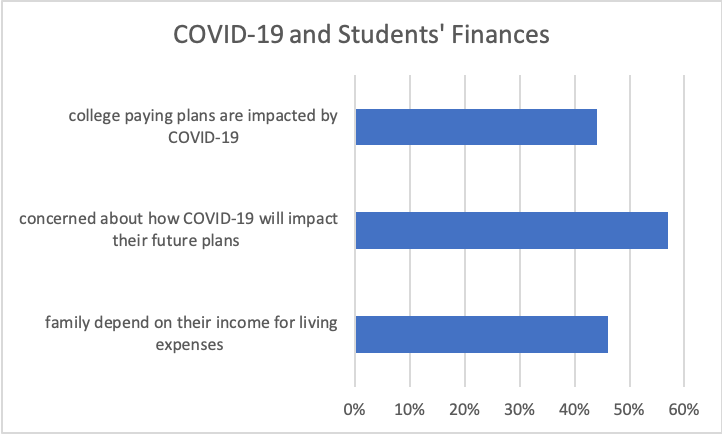
The impact of coronavirus and students’ finances. Data from Junior Achievement by Citizens Bank/Citizens One.
“I know financial circumstances have made people I know unable to continue the next semester or they are barely getting by,” Lin said.
Organizations like JED prioritizes sharing free resources that more people will be able to access on remote learning for faculty and staff as well as student newsletters about finding peace among all the current chaos, according to Cusumano
Finance-related issues like food insecurity also lead to increased levels of anxiety and depressive symptoms, and while there is a general feeling of anxiety and panic with everyone, it can be even harder for those with pre-existing mental health conditions, according to Cusumano. With students being away from campus, previous resources like free food pantries and meal plans are now inaccessible. This led to students requesting refunds from their universities on tuition and meal plans but are met with no compensation.
“There is a lot of panic on food and finances as well,” Cusumano said. “Whether it’s with those who can’t afford to buy food or maybe just when you go to the supermarket and you can’t find what you normally need.”
Students are always encouraged to reach out if they need anything and there are free resources available, said Cusumano, referring to multiple schools like American who are providing a 24-hour crisis intervention helpline from any location.
Mental health conditions of people in general are expected to worsen as the situation of the coronavirus escalates and news coverage continues, according to the CDC. This is expected for mental health support providers as well who may feel a little burnt out from all the work they are doing, Cusumano said.
In times where providers feel burnt out, they are encouraged to go back to their “why?” of getting into this field of work and think about the people that you are helping. This is also a time where support providers are more in touch with each other than ever, which helps to remind us that we are not alone, according to Cusumano.
With the prevalence of the virus, the CDC recommends parents to keep a schedule to create a routine for their children and to also limit their family’s exposure to news coverage in order to prevent children’s misinterpretation and additional fear about the situation.
Mental health support providers are aware of all the problems that come with going remote and are still working out the kinks of telehealth but are trying their best as they go along, Green said. Taking care of yourselves and knowing that you are not alone are the most important things to remind yourself of, according to Cusumano.
“Allow yourself some grace and give yourself permission to feel how you feel,” Cusumano said. “You can only as much as what you do right now.”
 Advanced Reporting Times, Spring 2020