
After a serious car accident that almost took her life in 2006, Amy Mellen quickly became dependent on a slew of pain medication prescribed by her doctor. When the opiates and nerve medication she was taking caused her to black out while driving on the highway, she knew that she needed to find an alternative.
After researching the medical cannabis program in her home state of Oregon, she began recovery through medical marijuana by smoking for the first time in 2014. Things began to turn around quickly when she discovered full extract cannabis oil in spring 2015. According to Mellen, within six months of ingesting the oil, she was off all prescribed medication except one. She dropped over 100 pounds in less than a year, reversed Type 2 Diabetes and no longer had to take 40 pills and supplements every day.
“Medical cannabis gave me a 180-degree turnaround,” she said in an interview.
In uncertain times presented by the coronavirus pandemic, Mellen, who now resides in Waldorf, Maryland, is thankful to maintain a sense of normalcy when it comes to accessing the medicine she counts on for her wellbeing. Her local dispensary is considered an “essential business” and is maintaining normal operations.
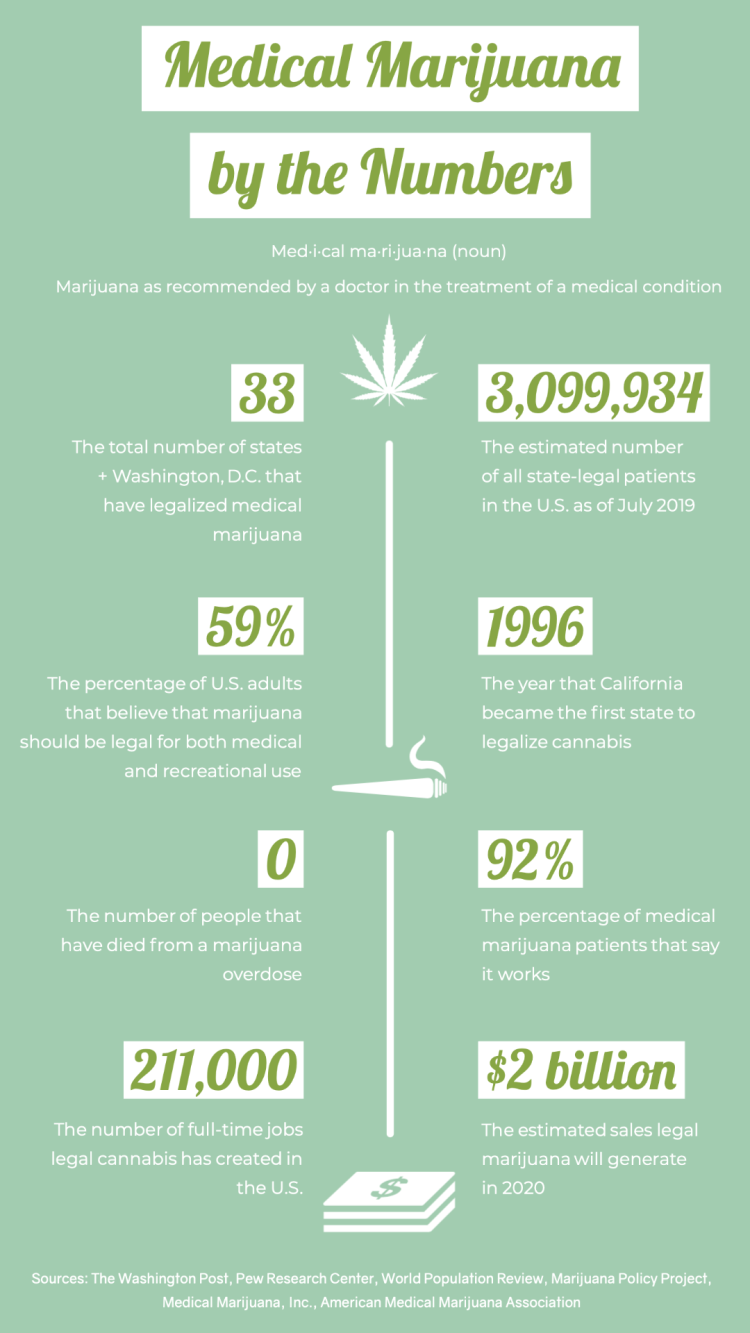
Mellen is one of over three million Americans across 33 states who depend on medical cannabis to treat a wide-ranging list of health conditions, according to data from Marijuana Policy Project.
While marijuana continues to be researched and tested, health professionals have found that two components of the drug have wide-reaching medical benefits – THC and CBD. THC is the main mind-altering compound in marijuana that makes users feel a euphoric “high” whereas CBD is non-psychoactive compound and considerably less controversial of the two.
Both cannabinoids – derived from the cannabis plant – are effective in treating chronic pain, which is the most common use for medical marijuana in the United States. It’s shown to work – in a 2017 survey of 2,897 Californian patients, 92% of respondents agreed that cannabis works better to treat their condition than a non-opioid medication.
Adam Ostrow, a retired physician who lives in Gaithersburg, Maryland was largely bedridden before using medical marijuana. He says that taking CBD and low dose THC products on a daily basis has been “completely transformative” in treating chronic pain.
“Medical cannabis is absolutely essential to me functioning,” Ostrow said in a phone interview. “I need it to get out of bed, to walk around the house and to do any kind of physical activity. Without it I’m in excruciating pain and not functional at all.”
Naturally, when states began issuing stay-at-home orders and patients feared losing access to their medicine that they so desperately rely on, the legal cannabis industry saw record sales. To the relief of the millions of Americans that count on medical marijuana for their day-to-day functioning, dispensaries were deemed essential in most states where the businesses are legal –an incredible feat for an industry that has been challenged and demonized for decades.
“To me, this is a recognition that [cannabis] is an essential part of my life,” Ostrow said. “It’s just like any other kind of medicine that I take.”
An ever-evolving industry, the legal marijuana business is making state-by-state changes to adapt to new challenges presented by the outbreak.
Haven, a medical cannabis dispensary in Brandywine, Maryland, is remaining open for normal business hours but enforcing a curbside pickup only rule. According to the manager of Haven, who asked to remain anonymous, all transactions must take place outside of the dispensary in order for patients and staff members to adhere to social distancing guidelines. Haven is also encouraging patients to place orders online prior to arrival. As for operations inside of the building, staff members are constantly disinfecting surfaces and moving around the space less than they normally would.
Haven’s manager says patients seem to be satisfied with the dispensary’s services given the unprecedented changes in operation.
“Patients have been patient, understanding and appreciative, so we have been very lucky,” she said in a phone interview. “I’m not sure if that’s the case with dispensaries all throughout Maryland, but our customers have been great and supportive.”
Despite dispensaries like Haven being declared life-sustaining businesses in the midst of strict stay-at-home orders, they are not eligible to receive relief funds from the federal government.
Under the massive $2 trillion CARES Act, small businesses who participate in the Paycheck Protection Program can receive loans to cover payroll, health care benefits, rent, and other expenses necessary in order to stay afloat amid COVID-19’s lifespan. Because marijuana distribution and sales are still illegal under federal law, dispensaries will have to support themselves through the crisis without government assistance.
“We’re fortunate to have a lot of support from patients and it hasn’t been necessary to change hours or do any reduction in sales force, so I’ve been able to continue keeping all of the employees that want to continue working, employed,” Haven’s manager said.
Not only are cannabis businesses ineligible for aid, but so are the companies that work directly or indirectly with such businesses – like some accounting services and law firms. Major banks and credit card companies are hesitant to work with dispensaries due to fears of federal drug charges and money laundering claims, so dispensaries must operate as cash-only businesses. The coronavirus can live on porous surfaces like dollar bills for up to 24 hours.
Along with enforcing the use of gloves and masks, Haven has been setting up stations where employees can disinfect areas with rubbing alcohol before and after handling cash, according to the manager.
Patients and dispensary owners believe that the financial barriers faced by businesses speak to a larger issue of the government’s outdated stance on cannabis.
Cannabis is considered a Schedule I drug under the Controlled Substances Act. The Drug Enforcement Administration classifies it alongside drugs like heroin and LSD as a substance with “high potential for abuse” and “no currently accepted medical use in treatment in the United States.” The schedule system sets the groundwork for the federal regulation of a substance. While there are disparities within states, Schedule I and II drugs receive the strictest regulations.
Americans for Safe Access (ASA) is a Washington, D.C.-based advocacy group with the goal of ensuring safe and legal access to cannabis for therapeutic use and research. Despite the fact that ASA is an advocacy group and does not deal with marijuana in any physical form, Interim Director Debbie Churgai says that she’s unsure if her organization will be eligible to receive federal aid.
“This whole issue highlights why [federal] legalization does need to occur,” Churgai said in a phone interview. “There’s inequality in terms of what is happening in the states – whether they’re keeping dispensaries open, whether they’re keeping cultivation sites open, whether they’re allowing delivery or not. It’s different per state, and it shouldn’t be that way. We should all have equal access to this medicine.”
Dispensaries in the nation’s capital that serve over 6,000 registered patients have been adjusting to the outbreak in unprecedented ways. On April 14, Mayor Muriel Bowser and the D.C. Department of Health announced an emergency rule allowing dispensaries to offer delivery and curbside pickup options. Patients enrolled in the District’s medical program or a similar program in another state may make use of pickup or delivery services through Aug. 12.
“This patient-centric, emergency rulemaking is necessary to protect the health, safety, and welfare of District residents, and is similar to what other states are putting in place to continue access to medical marijuana,” the city said in a press release.
The emergency rule includes stipulations. A driver cannot make more than 10 deliveries in a single run, vehicles cannot be marked with marijuana-related advertisements or imagery, and an order cannot exceed the 30-day limit of 4 ounces.
Patients and activists are pushing for states to make additional changes regarding their medical programs throughout the duration of the pandemic, such as implementing a temporary freeze on the expiration of medical cards and increasing the amount a patient can purchase each month.
Congresswoman Eleanor Holmes Norton (D-D.C.) is calling on the government to repeal the rider than prohibits Washington, D.C. from commercializing recreational marijuana, which would generate much-needed tax revenue as the city faces an economic crisis. Because the District is defined as a territory and not a state in the CARES Act, it is receiving $500 million, whereas all other states, including those with smaller populations than D.C., are promised $1.25 billion.
“At this moment of unparalleled need, D.C. should be able to collect tax revenue from all available sources, like every other jurisdiction, including from recreational marijuana, which is believed to be widely used in the District,” the congresswoman said in a press release.
While money plays a crucial part in the conversation surrounding marijuana, activists and dispensary owners say that their main focus is to ensure that patients have access to their medicine both during the pandemic and after it subsides.
Along with more curbside and delivery options, cannabis advocates would like to see changes in the caregiver policy. Caregivers are designated individuals who assist in purchasing and transporting medical cannabis to a patient who would have trouble accessing it on their own. Allowing caregivers to serve multiple patients as opposed to just one – which is currently the law in some states – would ease the burden on patients who don’t have easy access to their dispensary.
Patients would like to see increased telehealth options for new and renewing medical cannabis cards. Through virtual appointments, patients can visit their doctor from the comfort of their home, saving both time and transportation costs.
Rather than take away the delivery and telehealth options that are currently benefitting disabled and elderly medical marijuana users, ASA hopes that states will look into upholding these regulations after COVID-19 runs its course.
“There were patients that had mobility issues or were homebound before coronavirus came along. We want to make sure that patients like that are always kept in mind and helped,” Churgai said. “We are hoping that some of these regulations continue on.”
Despite the challenges presented by the pandemic and the work that still needs to be done, Mellen says that she and her fellow patients are “extremely grateful” that numerous states have included dispensaries within their list of essential businesses.
“[States] are saying that our medical cannabis patients have just as much of a right to their medicine as anybody that walks into a CVS, a Walgreens or any other pharmacy,” she said. “This speaks volumes for our industry and our community.”
 Advanced Reporting Times, Spring 2020