By Terrence Kane

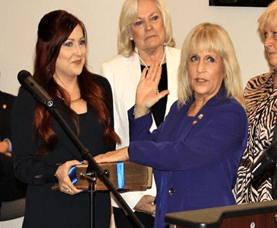
NEWTOWN, PA – It was late on a Sunday night when State Representative Perry Warren called me for a conversation on how Pennsylvania’s state government was handling the coronavirus outbreak. There was exasperation in his voice, and he spoke with a sense of urgency that seemed uncommon for a weekend night.
He called while he was out on one of his regular nightly walks, one of the few moments that he takes for himself. But even this solitary moment is not without work, it gives him time to return the calls that may not be pressing enough to handle during the week.
“For me, as a representative, I have been working non-stop, seven days a week,” Warren said over the phone. This work goes far beyond working with his fellow elected representative to enact emergency legislation, which dominated his work week. It also includes keeping in contact with many of his constituents and helping them deal with emerging problems during the outbreak; tasks which occupy most of his nights and weekends.
Warren was just one of several local government officials interviewed for this article who make up the frontline in the battle against the coronavirus. He spoke to how the state government was working to pass bills specifically aimed at generating relief among his constituents, such as allowing virtual marriage licenses and expanding access to unemployment benefits.
“I sat at my computer Friday night from about 6 to a little after midnight and just hammered out responses to probably a hundred emails,” he said in the interview. Despite plowing through nearly a hundred emails, it only made a dent in his current workload. He described the work as “not catching up but making some progress on the emails.”
Representative Warren is a Democrat representing Pennsylvania’s 31st district in the state House of Representatives since 2017. He is just one of more than two hundred elected state legislators in Pennsylvania who have found themselves working overtime to manage the coronavirus outbreak. Despite this, it is unlikely you will see him, or any of his colleagues or counterparts on the major cable news channels.
While major news companies have taken to interviewing talking heads and federal officials with significant name recognition. Giving airtime to senators and congresspeople who, while also working diligently to keep emergency funding to the states, are scarcely on the frontline in the same way as our local elected officials.
As a result, major news organization have left uncovered a vast wealth of state and local officials who have a true understanding of what it means to be on the frontlines of legislating a medical crisis. While it was often difficult to contact federal elected officials for interviews pertaining to this story, local officials and their staff were happily accommodating in finding a time to speak with me.
Local and state elected officials are on the frontlines of handling the implications of the coronavirus outbreak and have demonstrated their forward thinking on solving this crisis. These officials were able to take stronger, more concrete steps to addressing the outbreak than their national counterparts, and they did so much sooner.
For instance, while the U.S. House of Representatives still has yet to work out a safe and efficient way to vote on legislation, the Pennsylvania state legislature had solved that problem more than a month ago. Warren said, “The house of representatives met in person on Monday, March 16th and I drove out to Harrisburg. We caucused and did meetings by conference call…alone in my office, and with each member alone in their office.” Staff and team members were either told not to come in, or to maintain the social distancing guidelines.
Among the emergency legislation that the State House passed during this in person session was a bill that would allow for the House to move forward with remote voting. Warren noted that “we had to vote that in person because there was no provision for voting remotely. So, you can’t vote remotely to vote remotely.” This means that most state representatives no long have to return regularly to the state capital to cast their votes on legislation.
“The speaker and the party leaders are actually still on the floor of the house, but I can give my vote to the democratic whip who then casts my vote for me on the floor,” Warren said in the interview explaining the new process by which the State House will be approving legislation.
As work for state representatives ramps up in the context of the outbreak, so has the work of the staff that keeps their offices moving smoothly. While most of these employees have not seen the content of their work change substantially, working from home has definitely generate creative solutions to some typical problems.
Ryan Levitz, a former reporter for several small paper across the Midwest, works in Representative Warren’s office on the constituent relations team. Levitz has been with the Bucks County office for more than a decade, first coming to work for Warren’s predecessor and staying on after Warren’s election in 2016.
In some ways, there was a sort of fateful coincidence to the fact that a disease like coronavirus had not historically breached the U.S. at these level until 2020. “I won’t say this came at the right time, because there is never a right time for it, but it came at a better time than ten years ago,” Levitz said in the interview.
He explained how the technological developments over the past decade had given the adequate tools to government officials, and the country at large, to deal with such a widespread disruption to daily life. Without tools like videoconferencing, and other developments in the realm of telecommunications, government work likely would have grinded to a halt. “If this would have happened ten years ago, I don’t know if everything would be as well functioning,” Levitz said in the interview.
However, Levitz went on to describe how technological advancement has been completely without drawbacks. “A lot of documents we can email now, and can submit through email,” he said, “but some of the constituents in their mid-80s and up still aren’t on email so we can’t email them.” Levitz also noted how many people, himself included, no longer own printers which makes filling out and mailing documents significantly more challenging.
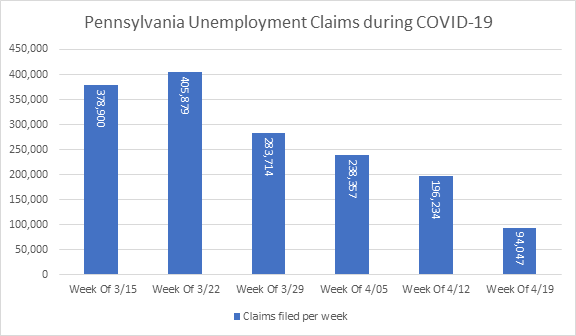
Fortunately, this was something that the Pennsylvania state government had anticipated and planned for according to Levitz. “Most of the deadlines for the state have been pushed back so I can just say can we revisit this in a month,” he said in the interview. That month is a much-needed cushion for state offices overrun with forms and documents, particularly those related to small business relief and unemployment benefits. Unemployment benefit applications have surpassed historical averages by as much as ten times, according to Warren’s office.
Despite the fact that the state government of Pennsylvania is working in overdrive to manage to coronavirus situations on the ground, it still pales in comparison to the massive burden undertaken by local elected officials. Local officials such as Mayor and County Commissioners are generally leveled the more challenging engaging actively in their communities to keep their constituents safe.
Local officials often have heavier and more diverse workloads to begin with as they are responsible for managing practically every part of daily life in their communities. Commissioners have a wide range of responsibilities that range from infrastructure management to healthcare, from law enforcement to unemployment. That explains why Diane Ellis-Marseglia, the chair of Bucks County’s Board of Commissioners, oversees almost three thousand workers along with her fellow two commissioners.
“Just under the commissioners falls the jail, the county nursing home, the department of health, 20 parks; 130 bridges; children and youth, which is 200 social workers who do abuse and neglect investigations; drug and alcohol commission, the entire mental health and disability programs that are run in Bucks County. We run the elections, and we supervise nine other elected officials,” Ellis-Marseglia said in the interview. The incredibly assorted workload that these local officials must shoulder means that they are fighting the coronavirus outbreak on practically every front.
According to Anna Payne, executive assistant to Commissioner Ellis-Marseglia and member of the Middletown Board of Supervisors, local officials have adapted well to the post-virus working conditions. “I think the biggest difference, obviously, is there is no face to face interaction,” she said in a phone interview. “But, like, even at county and municipal level it seems like everybody is easily transitioning into virtual communications.”
Payne explained how moving public meetings to virtual spaces were one of the bigger adjustments local official needed to make. “We’re not meeting in person but we are still trying to allow folks to participate by calling in and asking questions,” she said in the interview.
For local officials like Payne, it is not only important to make these meetings easily accessible, but also easy to participate in. “That was kind of an adjustment,” Payne said in the interview, “I think that is probably the biggest adjustment, trying to figure out how to get your public meeting to be virtual but also be inclusive, so everybody can participate and not just watch it on T.V.” The coronavirus outbreak has affected local officials on numerous fronts, including constituent relations beyond public meetings.
“The covid thing has touched a lot of areas,” Ellis-Marseglia said in the interview, “The jail, we had to get people out of the jail. We wanted to reduce the population of people who didn’t really have to be there because that was important because covid was gonna get in there.” Jails have been among the hardest hit sections of society, along with nursing homes. Ellis-Marseglia and her fellow Commissioners took early steps to reduce the spread of the disease among these vulnerable populations.
“We have a nursing home. My mother is in that nursing home. She’s been there for seven years,” Ellis-Marseglis said in the interview. She described how the board took early steps to protect nursing home residents, and how they continue to offer advice to nursing home and the community in general. “We needed to try and stop visits in the nursing home, I think March 10th, before anything else happened. And because the board of health is under us, we have 30 people working probably 18 hours a day, and a doctor, advising the entire community on what they should be doing,” Ellis-Marseglia said in the interview.
However, the commissioners’ jobs go well beyond simply overseeing the dispensing of advice. “We’re real hands on in this,” Ellis-Marseglia said in the interview, “We’ve had to make sure every hospital, every nursing home, the ambulance, the police, everybody has PPE (personal protective equipment).” A task easier said than done, as the nation is suffering from a widespread shortage of PPE. Ellis-Marseglia said it often comes down to making sure PPE goes to the people who need it most, leaving other to make due with what is left over.
Finally, Ellis-Marseglia explained how the local response needed to go beyond practical implications to consider legal and societal consequences. Ellis-Marseglia said that “because we answer the phones at 9-1-1, something people don’t think about, but it was a pretty big controversy that do you release the names to the police when they go to a house, or an ambulance squad, that we know that person has Covid-19 or is that a violation of someone’s privacy.” It fell on local officials, like Ellis-Marseglia and her fellow commissioners to develop a plan of action to protect the health of first-responders and the privacy of their constituents.
Ellis-Marseglia explained that it has been a rapidly evolving process. “At the beggining we wouldn’t do anything unless you asked and we would tell them,” she said in the interview, “Then we finally got a code, for example 4-2. If there is a person with covid at that house, we’ll say there’s a 4-2, without the officer asking.”
“So that’s a pretty big deal because it could be a HIPPA violation,” Ellis-Marseglia said citing a federal law designed to protect personal health information from public disclosure. “There are a lot of decisions on that,” she said.
In this unprecedented coronavirus epidemic, it is crucial that every level of government be on top of responses to every problem that arises. But those who will face those issues first and need to be innovators in developing solutions will be local officials. Regardless of whether they receive their due publicity from the press, it is important we all remember just how important local government truly is in times of trouble.
 Advanced Reporting Times, Spring 2020