Emma Dion // April 26, 2020 // Revised May 1, 2020

social distancing standards set by the CDC.
Credit: Jeannette O’Connor
WASHINGTON – Government officials across the United States are urging Americans to follow stay-at-home orders as the coronavirus outbreak continues to grow. But for many, that private home doesn’t exist.
Californian Tony Otto lives out of his car. The aspiring film artist has been experiencing homelessness for nearly four years now, ever since a divorce settlement left him with little. He has a job disinfecting a local bank twice a day, as well as a real estate office in Ojai, but says he is “vastly underemployed right now, it’s like 20 hours a week.”
Otto has Crohn’s disease, which puts him at a higher risk for severe illness if he contracts COVID-19, the disease caused by the novel coronavirus. Even so, Otto says that he is better off than many others who are experiencing homelessness.
California has the largest population of homeless people in the country. According to the World Economic Forum, California’s homeless population soared 16% last year to over 150,000.
In Otto’s hometown Ojai, a wealthy city just north of Los Angeles, homelessness is rare. Otto says there are only a few people living on the streets. One of them has caught his attention in recent weeks.
This person frequents many of the businesses in Ojai that are still open- drug stores, grocery stores and gas stations- asking for help. Otto says he often sees the man eating and drinking out of public trash cans around town.
“I noticed this individual begin to appear ill, exhibiting symptoms of this illness SARS-COVID-19. Most notably a serious cough. And signs of fever. This was alarming. However, what I witnessed in response to this was even more alarming,” Otto explained over the phone.
Otto decided to call emergency services to help the man. They arrived in minutes, he says, wearing full protective gear. Otto says he was surprised to see that the healthcare workers never tested the homeless man and allowed him to walk away after answering some questions.
In the days following the incident, Otto says that the individual continued to mingle about near grocery stores in Ojai, asking for change, food and cigarettes. Otto speculates that since fewer people are going out to go shopping amid stay-at-home orders, homeless people all over the country that rely on panhandling are receiving less help.
When it comes to those in need in Ojai, there aren’t many resources as it is, says Otto. “As soon as I became homeless, I tried to find help. There’s nothing.”
Otto says that in the Ojai community, wealthy locals are more likely to push the homeless out of sight than to lend a helping hand. “There’s a lot of wealthy people in this town,” says Otto, “and from what I understand, knowing political people, they’re like ‘we don’t really them here, we don’t want to be a magnet for them. We want to be a magnet for tourists.’”
Many of California’s homeless residents end up at encampments, where living conditions have created a petri dish-like setting for this virus to thrive, according to Otto.
“They don’t want to see death and disease and poverty, so it gets pushed into the corner. Right near Hollywood, right near downtown L.A, when you’re driving on the 101, you can see homeless encampments right there in plain view on the hillsides, right below those big houses. Like tents, tarps, and you know, just piles of debris. And nobody ever helps those people.”
In an effort to remove California’s homeless population from public streets during the coronavirus outbreak, Governor Gavin Newsom has partnered with the federal government to create Project Roomkey, which has provided California’s homeless population with hotel rooms to isolate in. These efforts have been met with some backlash from locals, including in the L.A. area.
Otto says that in the past few days, he hasn’t seen the homeless person panhandling in his usual spot. He hopes that the individual is quarantined in one of the hotel rooms in the Ojai area, because “literally there’s nowhere to go, unless you are lucky enough to get one of those hotel rooms.”
Across the country in Washington DC, officials are working hard to ensure that the homeless population has enough resources. DC Mayor Muriel Bowser has stated at several press conferences that she intends to prioritize the capitol’s most vulnerable populations.
On April 28, Mayor Bowser opened The Brooks, DC’s newest short-term family housing facility. “At a time when we face unprecedented challenges, The Brooks reminds us that our most vulnerable residents of the District deserve the safety and security of a home when they fall on hard times,” said Mayor Bowser, according to a recent press release. “Particularly during this public health emergency, we will continue to support our families and provide them with wrap-around services they need to transition into permanent housing. We’re all in this together.”
Like California, hundreds of hotel rooms in the District are being rented out to the city’s homeless population. Individuals are being encouraged to self-isolate in a hotel room if they have tested positive for the virus, if they are waiting for test results, or if they have been exposed to the virus.
The United States Interagency Council on Homelessness reported that there were over 6,500 people experiencing homelessness in DC as of January 2019. According to Department of Human Services data, as of April 30, 286 homeless individuals are occupying hotel rooms in DC.
“All of the District’s low-barrier shelters, family shelters, and shelters serving youth remain open 24-hours. Residents who do not have a safe space to stay should call the DC shelter hotline at 202-399-7093 or 311 any time of the day or night. For adults without minors in their care, the hotline will direct you to a shelter that has availability,” DC Department of Human Services Director Laura Zeilinger said in a video released by Mayor Bowser in late March.
Shelters across the District are keeping their doors open to those in need, but space is filling up fast. Ever since the coronavirus began taking a toll on the economy and unemployment numbers began to climb, emergency shelters in DC have seen an increased need for resources such as food.
Ken Forsythe, the Communications and Marketing Manager at DC’s Salvation Army, says that many people who have come to the Salvation Army facilities in the past month are first timers.
According to Forsythe, the Salvation Army filled 2,066 grocery orders throughout their fiscal year for 2019. But in the past four weeks, the organization has filled over 1,100. Although they are seeing a major spike in need, the Salvation Army has still been able to compensate for everyone who has reached out for help so far.
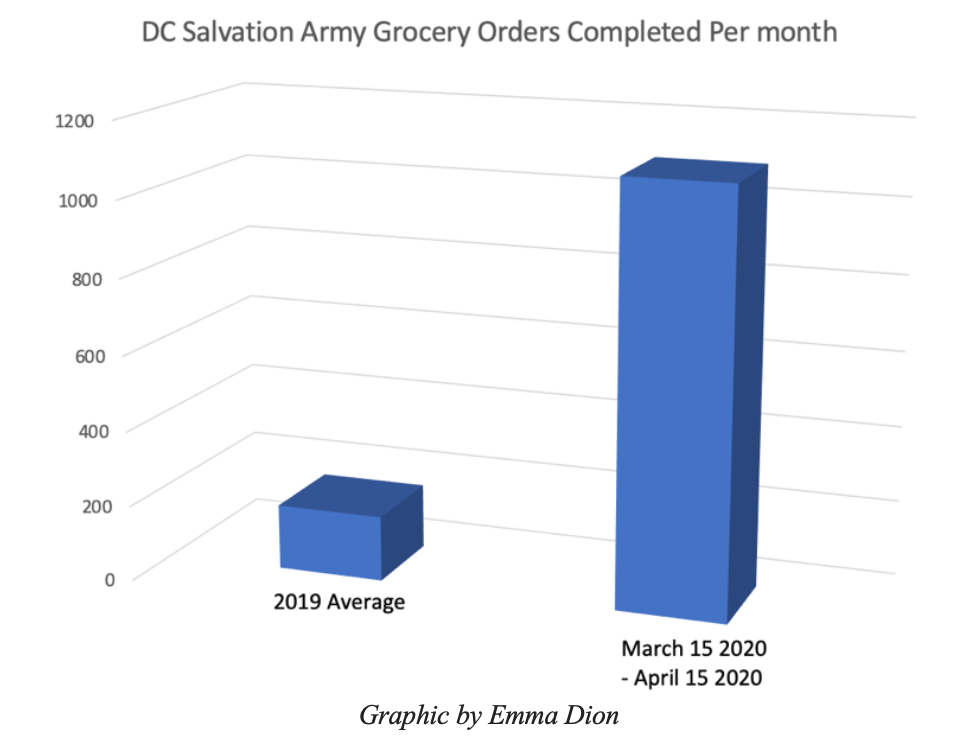
“With the influx of new faces that we’ve seen, that need has really meant that we need more in the way of financial resources to continue meeting the community’s needs. And you know, that’s one of the bigger issues that we’re confronting right now,” Forsythe said over the phone.
The lack of financial support is also a considerable concern for Sasha Bruce Youthwork, DC’s leading provider of homeless youth services, says Founder and Director Deborah Shore, who says that “it’s hard to see around the corner here.”
The organization recently had to postpone its 45th Anniversary Benefit to End Youth Homelessness so it could concentrate on the debilitating impacts of COVID-19 on the area’s homeless youth.
Shore says that Sasha Bruce Youthwork will lose a significant amount of money from ticket sales they would have earned from the Benefit. She says she’s concerned about the organization’s long-term budget, since they are already paying staff extra to continue working inside the youth housing facilities.
To compensate for the lost funding, Sasha Bruce Youthwork has been encouraging donors to make a contribution to their Homeless Youth Rapid Response Fund, which is helping the organization to pay staff, as well as to purchase cleaning supplies and PPE for their facilities.
Shore says that one of the biggest challenges that the organization is facing in the wake of the coronavirus outbreak is the digital divide impacting the homeless youth who are transitioning to online classes.
Sasha Bruce Youthwork staff are helping their young residents to get hooked up and connected, which has not been easy. “The digital divide is very real,” says Shore, “having the connectivity is so critical.”
Another challenge that has hit Sasha Bruce Youthwork particularly hard has been keeping the residents of the homeless facilities to stay in place, minimizing their exposure to the coronavirus.
“That took a few weeks because for a lot of the young people, there were myths that it wasn’t going to affect them,” says Shore, adding that with better connectivity to the internet, the job has been made easier.
Shore says that there has been significant anxiety amongst staff members at Sasha Bruce who worry that young residents may be asymptomatic carriers of the virus without knowing it. Shore worries that if some of the youth living at Sasha Bruce were carriers but weren’t showing symptoms of COVID-19, they would not get access to testing.
“It’s insane to me that we know kids who have been exposed, but they don’t get tested unless they have symptoms, even though we know that people are the most contagious before they have symptoms,” says Shore. But her organization is not alone. Shore says this type of situation is happening all over the country, because “we just don’t have enough tests.”
In order to ensure that homeless facilities don’t become susceptible to the spread of COVID-19, they’re ramping up cleaning efforts across the board.
Like most of the homeless shelters across the District, Calvary Women’s Services CEO Kristine Thompson says her organization has been following guidelines laid out by the CDC. Calvary Women’s Services is also stepping up efforts to provide mental health support for its female residents and their children.
“We all know from our personal experiences that being isolated and social distancing is really challenging and so we’re trying to be mindful of that for the women that we serve, who may have experienced domestic violence or other health or mental health issues, this is really a challenging time,” Thompson said in a phone interview.
Many of the women who live in Calvary Women’s Services housing facilities are victims of domestic violence. With stay-at-home orders in place, the organization has seen an uptick of women and families in need of a place to stay. Currently, they only have the housing capacity for 95 women at a time.
According to Thompson, the economic fallout from the coronavirus has been a large hit to the women at the facility who were on a path towards stable housing, but now are facing unemployment all over again.
One of Thompson’s clients had a job in which she could work 40 hours a week plus overtime. After the coronavirus outbreak began, she was furloughed.
“She really talked about that as a gut punch, as a moment when all of the things that she’d been working towards, all the money she’d been saving, now felt like it was really coming to a halt, her plans to move to housing now are delayed,” says Thompson.
“It has been really challenging, certainly for the women that we work with, to know that they’ll have to restart when this is over, find new employments and begin that path toward moving out of homelessness all over again.”
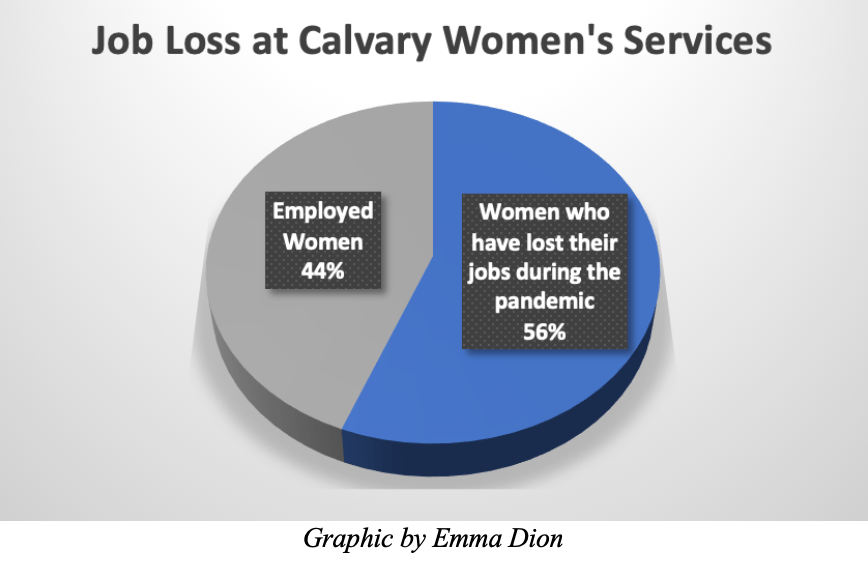
Of the women who were working before the coronavirus outbreak began, 56 percent have lost their jobs, according to Thompson. Many of them were working in retail or food and beverage fields. The women who are still working are employed in janitorial roles, or are healthcare workers, serving on the front lines of the fight against COVID-19.
When asked whether or not they thought Mayor Muriel Bowser was doing a good job to support DC’s homeless population, Forsythe, Shore and Thompson each said that they have no way to measure the impact of the government’s response to the outbreak.
Mayor Bowser’s office has begun releasing data about COVID-19’s impact on DC’s homeless population. As of April 30, 2020, 177 individuals in homeless shelters have tested positive for COVID-19. Nine individuals experiencing homelessness in the District have lost their lives due to COVID-19.
Looking to the future, Bowser is already brainstorming what DC can do, post-pandemic, to fix these deep-seated problems with vulnerable populations. Bowser addressed the situation head on at a recent press conference, stating “when we get to the other side, we need to focus, and continue to focus on generations worth of economic, housing, educational disparities that have led to these very tremendous disparities that this pandemic is putting a spotlight on.”
Homeless people around the country, including Otto, don’t have time to wait for a solution from local governments. Otto says he’s looking to find more work right now to keep him afloat during the pandemic. He says he’s interested in becoming a marijuana delivery driver for the time being.
“Deliveries have gone way up, so I mean I could do a delivery job. And I’ve applied. In town they have three dispensaries, so I applied for one of the jobs,” says Otto.
In times of monumental crisis, society has historically relied on nonprofit services for aid. The Salvation Army, Calvary Women’s Services and Sasha Bruce Youthwork each have been around for some time, surviving through past recessions and times of uncertainty.
“It’s very challenging, but I am deeply grateful for the staff and young people who are out there, keeping our doors open, and making sure that we don’t have people in the street alone,” says Shore, “the longevity of the organization helps me to feel confident that we’ll be able to find partners and helpers who will make sure we’re okay in the end.”
Shore says that through hard times, contingency planning is something the nonprofit world does best. According to both Thompson and Forsythe, organizations in the DC area are constantly working together to ensure everyone who needs assistance has access to it.
 Advanced Reporting Times, Spring 2020