Anxiety is increasing amongst grocery store workers as supermarkets remain open during this uncertain time. As a result, many grocery stores are transitioning to online delivery or curbside pickup services.
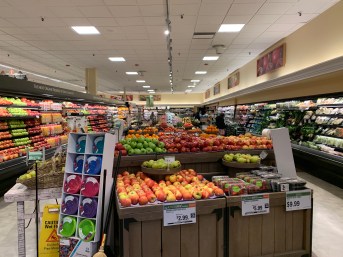
A police officer stood outside the Whole Foods in West Orange, New Jersey managing the inflow and outflow of customers while ensuring customers were six feet apart. I asked the officer, Mark Rosenburg, how long he had been standing outside.
“It’s been about four hours, but thankfully pretty soon the guy with the afternoon shift will come to replace me,” he said. “It’s strange you know, usually on a Wednesday morning I’d be driving around trying to monitor traffic control, but here we are.” A customer exited and Rosenburg let me enter the store. Inside I saw masked consumers and gloved workers continuously stocking shelves.
Although it appeared the store was taking preventative measures, three days after I entered the store nj.com reported that two employees at the same Whole Foods location in West Orange have tested positive for the coronavirus. A company spokeswoman said the diagnosed employees are in quarantine and additional steps have been taken to sanitize the store. The store remains opened.
“We’ve taken serious measures to ensure our customers and workers are staying safe at this time,” the manager of the West Orange Whole Foods, Matthew Fowler, said in an interview. “Since those cases, we are trying to stay in line with the CDC guidelines. That’s why we are now being stricter, wiping down all carts left in the parking lot, and monitoring spacing guidelines throughout the store.”
It’s no secret people across the country and around the world are staying inside their homes to practice social distancing due to the coronavirus. Although individuals are encouraged to decrease the spread of the virus and remain home, many continue to fulfill basic household needs such as buying groceries. Because grocery stores are considered an essential business the guidelines and habits of consumers have shifted within the past month and a half.
Grocery workers all over the country have continued to report to work, with many describing long shifts and extra workloads to keep up with the high demand.
“I haven’t felt safe going into work, but I’ve got bills to pay and rent. I can’t afford to not show up to work,” said a Whole Foods employee in an interview who preferred to stay anonymous. “I’ve been in contact with so many people, putting my health at risk. It sucks.”
Whole Foods employees across the country have banded together to demand better conditions during this outbreak. Whole Worker, a Whole Foods labor organization, went on a national strike on March 31 in an effort to protest the Amazon-owned grocery store chain. The organization posted a statement on Twitter advocating for workplace safety and benefits including hazard pay and sick pay for employees who may be sick but haven’t been tested for the coronavirus.
“As this situation has progressed, our fundamental needs as workers have become more urgent,” Whole Workers said in the Twitter statement. “COVID-19 poses a very real threat to the safety of our workforce and our customers. We cannot wait for politicians, institutions or our own management to step in to protect us.”
The labor organization encouraged all Whole Foods workers to call out sick for the day. Despite the efforts of the protest, Whole Foods reported that store services continued across the country without interruption or any operational impact.
Despite the protest of Whole Workers, Whole Foods continues to operate and remain open during this outbreak. In an effort to combat the spread of the virus, Whole Foods is temporarily converting some stores to online grocery delivery service only.
By converting some stores, Whole Foods can decrease face-to-face interactions, keep workers safe and sustain the demand for online grocery shopping.
“With the new world of social distancing and stay-at-home orders in place for most of the country, customers have generated unprecedented demand for grocery delivery,” Whole Foods said in a statement. “As we navigate the challenges associated with COVID-19, we continue to find ways to increase delivery availability while navigating safety measures and social distancing.”
According to the CDC, it is recommended people order food and other items online for delivery or curbside pickup. As a result, online delivery services such as Amazon Fresh and Instacart have increased in popularity.
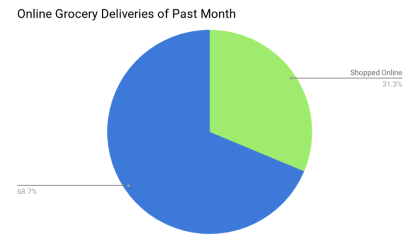
New research found that 31% of U.S. households have used online grocery delivery and pickup services over the past month. The report, which is based on a survey of more than 1,600 U.S. adults, found that 26% of these surveyors said this was their first time using an online grocery service.
The market value of online grocery shopping doubled from $12 billion in 2016 to $26 billion in 2018, suggesting consumers would continue to follow a trend of buying food online. According to predictions made by Business Insider analysts, online grocery shopping will continue to surge in 2020. But the consumer outreach will depend on the length of the quarantine restrictions.
As shoppers look to make fewer trips into stores, on-demand grocery shopping for delivery and curbside pickup has become increasingly popular. However, these delivery services are struggling to fulfill orders due to the high demand.
Instacart advises customers to check delivery times frequently and select a replacement in case their preferred items run out of stock. Yet in some cases, it still seems difficult for an average shopper to place delivery and receive their virtual order.
“I placed an order on Instacart for a delivery dropoff between 1-3 pm, but my groceries didn’t come until 6:00 pm. It’s not like I had anywhere else to be, but still, I used Instacart before coronavirus and considered myself a very loyal customer. They were three hours late and forgot to include some of the things on my list,” said Alice Stein, an avid online grocery shopper.
Companies like Instacart are trying to provide their service in an efficient way, but as these online services grow in popularity they are now forced to keep up with non-stop orders coming in. Although customers like Stein are finding the quality of the service dissatisfying, Instacart has set out to hire 300,000 new employees to pick and deliver groceries. Similarly, Amazon Fresh is also hiring 175,000 new delivery and operations personnel.
Because some of Stein’s groceries were missing she also feared that the U.S. was in the midst of a food shortage. However, Madison Calkins, a Resource Mobilization Associate at the International Fund for Agricultural Development, said in an interview that Americans should not be concerned with a food shortage at this time.
“Right now the issue is not a lack of supply and we are not facing a food shortage. The issue is the people who are transporting our produce as we speak,” she said. “If you’re wondering why you don’t see tomatoes, cucumbers, or other produce it’s a matter of our agricultural system and delivery service. This is a good time to reflect on who works in these supply chains. Americans shouldn’t be afraid and think we are going to run out of food.”
When grocery stores and online delivery services are out of popular items that are typically in stock, it is likely this item will be restocked within a day or two. The U.S. continues to produce enough food to meet demand because of the several million season agricultural workers.
“At this time we should be thinking of our agricultural farmers. Let’s hope farmworkers are able to follow effective social distancing guidelines, are wearing protective gloves and masks, and are able to get the medical care they need without fear of lost wages,” Calkins said.
 Advanced Reporting Times, Spring 2020