The Joint Economic Committee Hears Testimony on How to Improve Family Stability

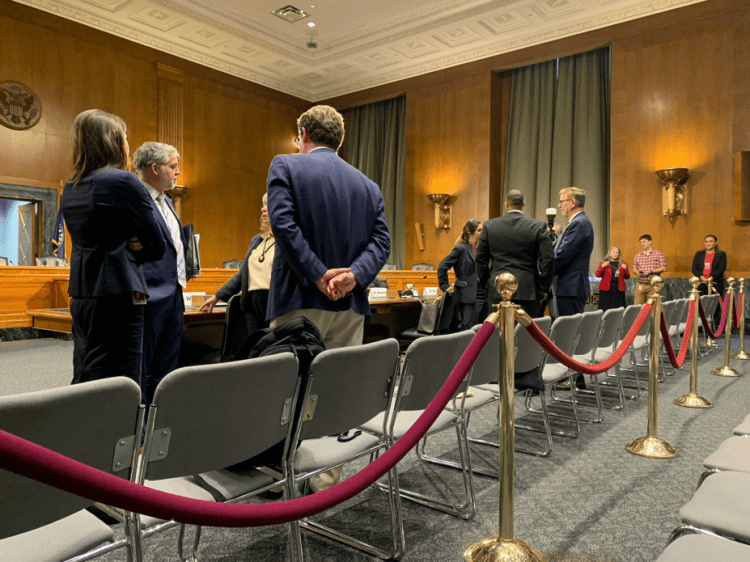
Testimonial Panelists chat prior to a Joint Economic Committee Hearing on Improving Family Stability for the Wellbeing of American Children.

By Emma Dion // February 27, 2020

WASHINGTON – In the heat of the 2020 primary season, a large pool of Democratic candidates are working hard to appeal to voters on a national scale. South Bend Indiana Mayor Pete Buttigieg champions his pro-LGBTQ family values through his own marriage. Vice President Joe Biden has called for policies to help minority African American families find prosperity. Presidential hopefuls are concentrating their platforms on new and improved policies that will generate interest from an increasingly diverse voter pool in the United States. 

The Joint Economic Committee heard testimony from four sociology experts on Tuesday afternoon at a hearing to discuss “Improving Family Stability for the Wellbeing of American Children.” Much of the hearing focused on the current family-related policy in the United States, which lacks the ability to support non-traditional and minority families. The testimony panel debated for over two hours about various solutions to fix this problem. 

Dr. Rashawn Ray, a David M. Rubenstein Fellow from The Brookings Institution, was the only person of color to provide testimony at the hearing and began his testimony with a question for those in the room to consider.   

“I grew up in a single parent household and have never seen my biological father before. I am now happily married to my high school sweetheart with two smart and talented boys. How did I get here?” 

Dr. Ray credited his successful upbringing to the determination of his single mother, Joslyn Talley, and the childcare and support that he received from his grandparents and aunt. 

Dr. Ray’s testimony spoke to the fact that when minority families are facing economic hardship, they turn to extended family arrangements for help. His research suggests that racially diverse families today are more likely to consider extended kin and grandparents as part of their family. 

This growing trend is not reflected by government policy currently in place. As Vice Chairman Don Beyer (D-VA) stated in his opening remarks, “the share multi-generational households has grown, but our policies haven’t changed. Grandparents, aunts and uncles are taking care of kids and are often doing it because the cost of childcare is unbelievable.” 

Dr. Ray’s sentiment was echoed by Professor of Economics and Public Policy at the University of Michigan, Dr. Betsey Stevenson, who called for better recognition and support for broader kinship relationships in her testimony. Stevenson pointed out that grandparents are playing an “important role in childrearing both for married and single parents,” because research shows that couples who live far away from their parents will likely move closer once they have children. 

When asked by Joint Economic Committee member and U.S. Congresswoman Jaime Herrera Beutler (R-WA) how policy makers should recognize the role of grandparents, aunts and uncles in providing care for kids, Dr. Ray was quick to suggest that “there needs to be greater flexibility and malleability in grandparents’ ability to take on some of the recourses and tax breaks associated with raising children.”  

Not everyone in the room was in agreement that grandparents are the key to increased family stability. According to Kay Hymowitz, a William E. Simon Fellow at the Manhattan Institute, the focus needs to be on the “marriageable men problem,” something Hymowitz considers to be “an underappreciated part of the story.” 

According to Hymowitz, as more and more women are getting higher education and entering the workforce, they are searching for men who also have higher education and well-paying jobs. Unfortunately for them, statistics show that fewer men are seeking that. Therefore, there is a “mismatch between what women might want [in a marriage], and the men available.” 

Hymowitz suggested policy ideas that offer methods to fix this marriageable men problem- “to ensure more children grow up in stable, two-parent families, we need to focus our attention on young men.” According to Hymowitz, that means focusing on improving their education. 

Hymowitz also drew attention to something “less amenable to government policy but is no less crucial to addressing the marriageable men problem.” In her testimony, Hymowitz brought up the need to re-affirm the importance of fathers and male contributions to the American family household. 

Despite not having a father in his childhood upbringing, Dr. Ray agreed with this sentiment, explaining that although his mother wasn’t able to show “what it means to be a black man in society,” she was able to introduce Ray to figures who could, which proved importance in his life.

Bringing the hearing in a new direction, Congresswoman Herrera Beutler urged a conversation about emotional health in relationships. She questioned the testimonial panel on the types of relationships society is modeling in 2020, asking “who wants to get married if they’ve seen a terrible marriage, or a terrible situation?”

In response, Dr. Stevenson pointed out that families with fathers who have an increasingly large role are the families finding success. She pressed that “modern masculinity does involve having a baby pouch on some of the time.”  

Dr. Stevenson’s message faced some backlash from Hymowitz, who was fast to object that having fathers participate more in family life “is not going to happen without marriage in any reliable way.” 

As the Hearing was coming to a close, Congresswoman Herrera Beutler expressed her belief that mutual love and respect is “ultimately how we get to more stable relationships and marriages.” This idea was something everyone in the room could agree on. 

Vice Chair Beyer addressed the fact that Congress has been working to pass legislation to improve economic stability for families. “I’m very pleased that our congress recently adopted the National Defense Authorization Act, which gave federal workers 12 weeks paid leave to care for a newborn or adopted child. I’m looking forward to expanding that to the private sector also.” But lawmakers aren’t nearly done making improvements for diverse, minority families. Beyer stated that upholding fatherly figures in the household is essential for future legislation. “Making paid family leave a reality for women and men will be another important step.” 
Public health experts identify drug manufacturing as a top vulnerability in the fight to contain the coronavirus in the United States

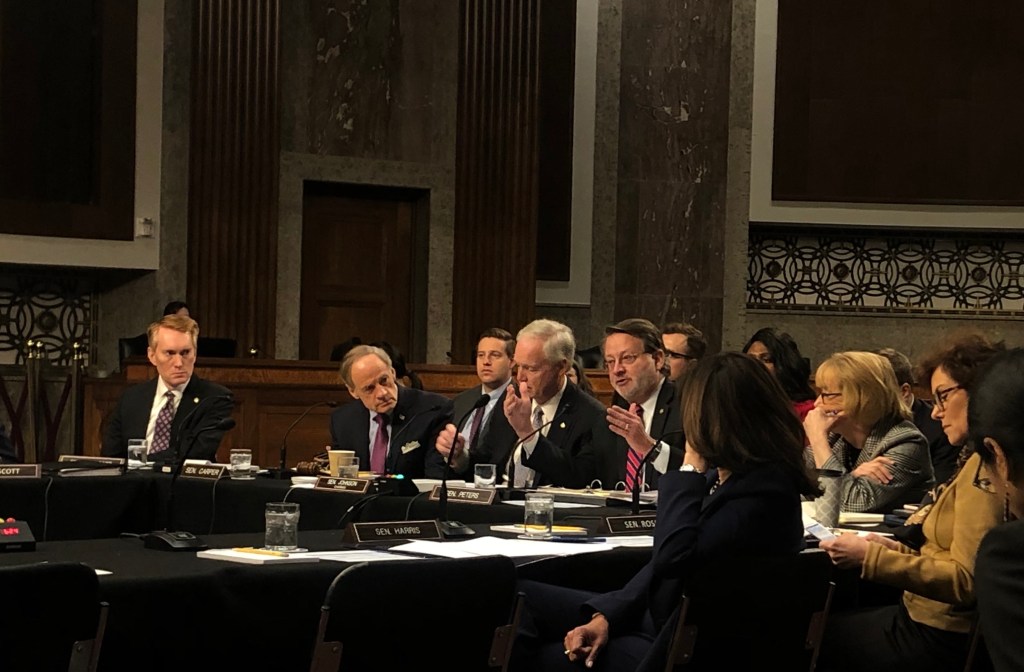
Ranking Member Gary Peters gives his opening statement at the roundtable discussion.

by Lindsay Russell // February 13, 2020 // last updated March 6, 2020

WASHINGTON – A panel of public health experts testified on Wednesday before the Senate Committee on Homeland Security and Government Affairs that the United States does not have the resources to handle a global outbreak like the novel coronavirus.

The panel agreed that one of the most serious threat the U.S. would face in the instance of a global pandemic would be the inability to produce enough pharmaceutical drugs and medical supplies to supply the U.S. population.

Dr. Scott Gottlieb, former commissioner of the Food and Drug Administration under President Trump, explained the process of drug manufacturing. The U.S. manufactures drugs insofar as putting active pharmaceutical ingredients (API) into tablets or syringes for vaccines, but China is often the “sole supplier” of the chemicals that create the API.

“What we’re finding now is, in many cases, China is the only supplier of these raw ingredients,” Gottlieb said. “What we’ve identified is a critical chokepoint in the supply chain.”

This means that in the case of a global pandemic, the Chinese government would not export the API needed to create vaccines and antibiotics until their local need for the drugs was sufficiently met, Gottlieb said.

Most drug-manufacturing companies typically have between one and three months of API on hand, which means that the U.S. may soon have a problem if the coronavirus outbreak is not contained, he explained.

The government considered critical chokepoints after 9/11, and manufacturers of critical products like insulin were required to identify alternate methods of supply if their primary facility were to become inaccessible, Gottlieb said.

“We should… require [drug companies] to report on intermediate steps and intermediate ingredients that could also come into shortage that could create an adverse public health outcome,” Gottlieb said. “We can require companies to identify alternative supply for some of these products.”

Committee Chairman Sen. Ron Johnson (R-WI) added that in order to mitigate chokepoints in the supply chain, the federal government needs to be working on a bipartisan basis to encourage pharmaceutical manufacturing in the U.S. in a way that is profitable for drug companies. “We’ve made it risky to manufacture because the risks are high of litigation,” Johnson said.

Dr. Luciana Borio, former director for medical and biodefense preparedness at the National Security Council under the Trump administration, told Johnson that the numbers being reported in China are likely being underreported due to a lack of resources. The global numbers will rise quickly as other affected countries like Singapore, Hong Kong, and Japan continue to report.

“The features are very concerning for a pandemic and global spread,” Borio told the committee. “I think we’re going to see a lot more cases in the United States in the future.”  

Dr. Julie Gerberding, former director of the Centers for Disease Control and Prevention, advised the committee to prepare for a prolonged outbreak. “We need to be leaning into what are the next steps if we can’t contain it,” she said. The primary goal should be to create a plan for how to sustain healthcare services if the Untied States sees a continued outbreak, she explained.  

The next step in combatting the coronavirus would be to shift resources to the nation’s healthcare system, which the panelists agreed is not currently equipped to handle a massive influx of infectious patients seeking treatment for an illness like the coronavirus.

Gerberding described the “herky-jerky funding” of the nation’s public health agencies as a major roadblock for improvements. “When something happens… we’re very competent at making an emergency investment and stepping up in the crisis to get miraculous things accomplished, but we don’t sustain it,” she said.

The American health care model puts an emphasis on preventative measures as the best practice for preventing medical emergencies. The “reactionary funding” that infuses public health agencies with money only during national emergencies like the corona outbreak doesn’t allow the agencies to support that prevention mission, Gerberding said.

Each panelist agreed that their respective former agencies need more funding to be able to sustain the level of work required to mitigate emergency outbreaks.

The additional funding would allow agencies like the CDC and the National Institute of Health to deploy public health experts to the center of an outbreak so that containment efforts can take place while the health risk is still outside U.S. borders.

The funding would also allow agencies to teach local hospital staff in rural America how to deal with a global pandemic, something they are not currently trained to do, according to Gerberding. Sen. Jacky Rosen (D-NV) called the community hospitals “the front lines” of public health crises.

Sen. Maggie Hassan (D-NH) noted the importance of creating medical diagnostic kits to test patients for the coronavirus. She asked the panel about the FDA’s involvement in that process.

Gottlieb explained that the FDA has issued an Emergency Use Authorization for the diagnostic kits, which allows the agency to bypass regulatory requirements for drug companies developing them. Drug companies and the FDA are now working together to get the kits into the market.

The coronavirus currently has a much higher fatality rate than the seasonal flu that Americans are used to, Gottlieb said. Panelists reminded the audience that frequent handwashing is still the best method of prevention as the public health sector works to contain the outbreak.

Sen. Johnson and the committee’s ranking member, Sen. Gary Peters (D-MI) both expressed disappointment that the current heads of the CDC and the Department of Homeland Security chose not to attend this public hearing.

Sen. Johnson told the audience at adjournment that those agency heads were briefing the Senate in a closed hearing later Wednesday morning.

Introduce Yourself (Example Post)

This is an example post, originally published as part of Blogging University. Enroll in one of our ten programs, and start your blog right.

You’re going to publish a post today. Don’t worry about how your blog looks. Don’t worry if you haven’t given it a name yet, or you’re feeling overwhelmed. Just click the “New Post” button, and tell us why you’re here.

Why do this?

  • Because it gives new readers context. What are you about? Why should they read your blog?
  • Because it will help you focus you own ideas about your blog and what you’d like to do with it.

The post can be short or long, a personal intro to your life or a bloggy mission statement, a manifesto for the future or a simple outline of your the types of things you hope to publish.

To help you get started, here are a few questions:

  • Why are you blogging publicly, rather than keeping a personal journal?
  • What topics do you think you’ll write about?
  • Who would you love to connect with via your blog?
  • If you blog successfully throughout the next year, what would you hope to have accomplished?

You’re not locked into any of this; one of the wonderful things about blogs is how they constantly evolve as we learn, grow, and interact with one another — but it’s good to know where and why you started, and articulating your goals may just give you a few other post ideas.

Can’t think how to get started? Just write the first thing that pops into your head. Anne Lamott, author of a book on writing we love, says that you need to give yourself permission to write a “crappy first draft”. Anne makes a great point — just start writing, and worry about editing it later.

When you’re ready to publish, give your post three to five tags that describe your blog’s focus — writing, photography, fiction, parenting, food, cars, movies, sports, whatever. These tags will help others who care about your topics find you in the Reader. Make sure one of the tags is “zerotohero,” so other new bloggers can find you, too.

Design a site like this with WordPress.com
Get started